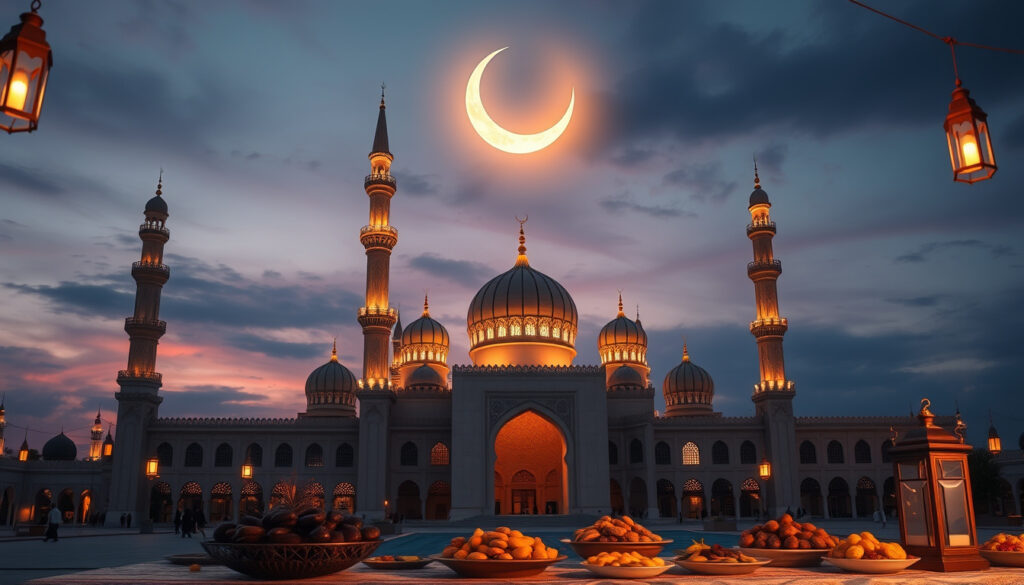
Eid al-Fitr 2026: Meaning, Celebration & Forbidden Act
For nearly two billion people, the end of Ramadan brings a burst of joy as families and communities come together over prayers, sweet food, and charity. This guide walks through what happens on Eid al-Fitr, what is forbidden, and how it differs from Islam’s other major festival.
Global Muslim population: approximately 1.9 billion ·
Number of Muslim-majority countries: around 50 ·
Eid al-Fitr 2026 expected date: March 20–21, 2026 (depending on moon sighting) ·
Duration of Eid al-Fitr: one day
Quick snapshot
- Exact Gregorian date depends on local moon sighting
- Specific forbidden behaviors beyond fasting vary by school of thought
- Celebration length (one to three days) differs by country
- Fasting obligation revealed in 624 CE (Wikipedia)
- First Eid al-Fitr observed in 2 AH (624 CE) after Battle of Badr (Wikipedia)
- Occurs annually on 1 Shawwal (Wikipedia)
- Eid al-Fitr 2026 projected for March 20–21
- Next major festival is Eid al-Adha in June/July 2026
- Charity distributions continue year-round
Key facts about Eid al-Fitr are summarized in the table below.
| Attribute | Value |
|---|---|
| Etymology | From Arabic “Eid” (festival) and “al-Fitr” (breaking fast) |
| First Ramadan | Ramadan fasting was made obligatory in 624 CE (Wikipedia) |
| Number of Muslim-majority countries | Approx. 50 |
| 2026 Gregorian date (probable) | March 20–21 |
What is Eid al-Fitr celebration?
Meaning and significance of Eid al-Fitr
- Eid al-Fitr means “Festival of Breaking the Fast” (Wikipedia)
- It marks the end of Ramadan, the month of dawn-to-dusk fasting (Wikipedia)
- Celebrated by Muslims worldwide with prayers, feasts, and charity
How Eid al-Fitr ends Ramadan
Ramadan lasts 29 or 30 days based on the lunar calendar. The sighting of the new moon of Shawwal signals the end of fasting and the beginning of Eid. According to Wikipedia, the month of fasting was ordained in the second year of the Islamic calendar (624 CE).
For the 1.9 billion Muslims globally, Eid al-Fitr is not just a feast — it’s a religious milestone that rewards a month of discipline with community-wide celebration. The shift from fasting to feasting is immediate and intentional.
The implication: Eid al-Fitr is the only day in the Islamic year when fasting is completely banned. This prohibition is consistent across all schools of Islamic law.
How is Eid al-Fitr celebrated?
Eid prayer (Salat al-Eid)
- The day begins with a special congregational prayer (Wikipedia)
- The prayer consists of two rakats with six additional takbirs
- It is performed in open fields or large halls
Zakat al-Fitr (charity before prayer)
Zakat al-Fitr is a mandatory charitable contribution given before the Eid prayer. Wikipedia notes that it is paid to the poor and needy. The amount is typically the equivalent of one meal per family member.
Festive meals and gatherings
Families and friends gather for festive meals after the prayer. Sweet dishes are commonly prepared (Wikipedia). Gifts are exchanged, especially for children.
Greetings like “Eid Mubarak”
Common greetings include “Eid Mubarak” (Blessed Eid) and “Eid Sa’id” (Happy Eid). Wikipedia cites these as the standard forms.
For non-Muslims wanting to join celebrations, a sincere “Eid Mubarak” is universally welcomed. The greeting crosses cultural and linguistic lines.
The trade-off: The emphasis on charity before feasting ensures that no one is left out. Zakat al-Fitr must be given before the prayer, making the celebration inclusive even for the poorest.
What is forbidden during Eid al-Fitr?
Acts not allowed on Eid al-Fitr
- Fasting on the day of Eid is strictly forbidden (haram) (Wikipedia)
- Excessive celebration contrary to Islamic teachings is discouraged
- Sinful behavior of any kind is prohibited
Comparison to forbidden acts in other contexts
Unlike during Ramadan when fasting is required and marital relations are prohibited during daylight, Eid lifts all fasting restrictions completely. The prohibition on fasting is unique to this day — even missed Ramadan fasts cannot be made up on Eid.
While the fast ban is absolute, other prohibitions vary by school of thought. Wikipedia notes that specific interpretations differ, so travelers should check local religious guidance.
What this means: The core restriction — no fasting — is universal across Islam. Beyond that, cultural norms shape what “excessive” means.
What is the difference between Eid al-Fitr and Eid al-Adha?
Four key contrasts separate the two festivals, one rooted in charity after fasting, the other in sacrifice after pilgrimage.
| Attribute | Eid al-Fitr | Eid al-Adha |
|---|---|---|
| Reason for celebration | End of Ramadan fasting | End of Hajj pilgrimage; commemorates Prophet Ibrahim’s willingness to sacrifice (Brandeis University) |
| Duration | One day (some countries extend to three) (Wikipedia) | Three to four days (Brandeis University) |
| Key ritual | Prayer, charity (Zakat al-Fitr), feasting | Prayer, animal sacrifice (Qurbani), distribution of meat |
| Charity focus | Zakat al-Fitr given before prayer | Meat distributed to family, neighbours, and the poor |
Reason for celebration
Eid al-Fitr celebrates completing a month of fasting. Eid al-Adha commemorates the end of Hajj and the obedience of Prophet Ibrahim. Brandeis University explains that the sacrifice recalls Ibrahim’s willingness to sacrifice his son.
Timing and duration
Eid al-Fitr falls on 1 Shawwal, lasting one day (though many countries extend public holidays to three). Eid al-Adha begins on 10 Dhul Hijjah and lasts up to four days (Brandeis University).
Key rituals
Eid al-Fitr involves a special prayer and obligatory charity. Eid al-Adha features the sacrifice of an animal (sheep, goat, cow, or camel) and the distribution of meat in three parts: family, neighbours, and the needy.
Regional variations
In the Maldives, Eid al-Fitr celebrations reportedly include cultural performances (Wikipedia). In Indonesia, the festival is known as Lebaran and includes a tradition of asking forgiveness. For comparison of another cultural festival, see Dia de los Muertos – Origins, Traditions and Key Facts.
The pattern: Both festivals share the core elements of prayer, charity, and community gathering, but the scale of sacrifice and the emphasis on pilgrimage set Eid al-Adha apart.
Why do Muslims have two Eids?
Islamic calendar structure
The Islamic year has two major festivals because each commemorates a different pillar of worship. Twinkl notes that the two Eids are rooted in the Quran and Sunnah.
Significance of each Eid
- Eid al-Fitr celebrates the completion of fasting (one of the Five Pillars)
- Eid al-Adha marks the end of Hajj (another pillar) and the spirit of sacrifice
Why this matters: Having two Eids reinforces the rhythm of the Islamic year — one after personal discipline (fasting), the other after communal worship (pilgrimage).
Clarity check
Confirmed facts
- Eid al-Fitr ends Ramadan (Wikipedia)
- Fasting on Eid is forbidden (Wikipedia)
- Zakat al-Fitr is required before Eid prayer (Wikipedia)
- Eid al-Adha lasts three to four days (Brandeis University)
What’s unclear
- Exact date of Eid depends on local moon sighting (Wikipedia)
- Specific prohibited behaviors beyond fasting vary by school of thought
- Celebration length (one to three days) differs by country (Wikipedia)
- Regional traditions (e.g., cultural performances in Maldives) are not uniformly documented
Perspectives from religious scholars
Eid al-Adha commemorates the willingness of Prophet Ibrahim to sacrifice his son as an act of obedience to God.
Eid al-Adha is also called the Festival of Sacrifice and is celebrated for three to four days.
Eid al-Fitr is characterized by feasting, gift-giving, and acts of charity.
For families in non-Muslim-majority countries like Ireland, the challenge is balancing religious obligations with school and work schedules. The choice is clear: plan ahead for moon-sighting announcements and communicate with employers about the likely date. Missing the Eid prayer because of a work conflict is a loss that can be avoided. For another religious observance, see Our Lady of Lourdes – Guide to France’s Miracle Site.
For a more detailed look at the expected dates and regional variations, readers can consult the complete guide on Eid ul Fitr 2026 expected dates and traditions.
Frequently asked questions
Can I say Eid Mubarak to a Muslim?
Yes, it’s a respectful greeting universally accepted. Most Muslims appreciate the gesture regardless of the speaker’s faith.
Do I have to give Zakat al-Fitr if I am already poor?
Zakat al-Fitr is obligatory only for those who have the means. If you cannot afford it, the obligation is lifted.
What prayers are performed on Eid al-Fitr?
The Eid prayer (Salat al-Eid) is a two-rakat congregational prayer with additional takbirs. It is performed after sunrise.
How do Muslims greet each other on Eid?
Common greetings include “Eid Mubarak” (Blessed Eid) and “Eid Sa’id” (Happy Eid).
Is Eid al-Fitr a public holiday in Muslim countries?
In most Muslim-majority countries, it is a public holiday lasting one to three days. In non-Muslim countries, it is not typically a public holiday.
Can non-Muslims join Eid celebrations?
Absolutely. Many Muslim families welcome neighbours and colleagues to share the festive meal and greetings. It’s a sign of community spirit.
What food is typically eaten during Eid al-Fitr?
Sweet dishes such as dates, pastries, and rice-based desserts are common. Regional specialties vary widely.
More related posts
 Celtic F.C. vs Kilmarnock F.C. Lineups: Predicted XIs & Team News
 Volkswagen T-Roc 2026 Review: Specs, Problems & Irish Prices
 Hotel Las Vegas Salou: Location, Amenities, Reviews & More
 Dog Friendly Restaurants Near Me – Best Pet-Friendly Dining Guide
 Premier Inn Dublin Docklands: Guide to Location & Amenities
 Ripley’s Believe It or Not: Worth Your Time
 Letterkenny Cafe Closure Order: FSAI Cases and Timeline
