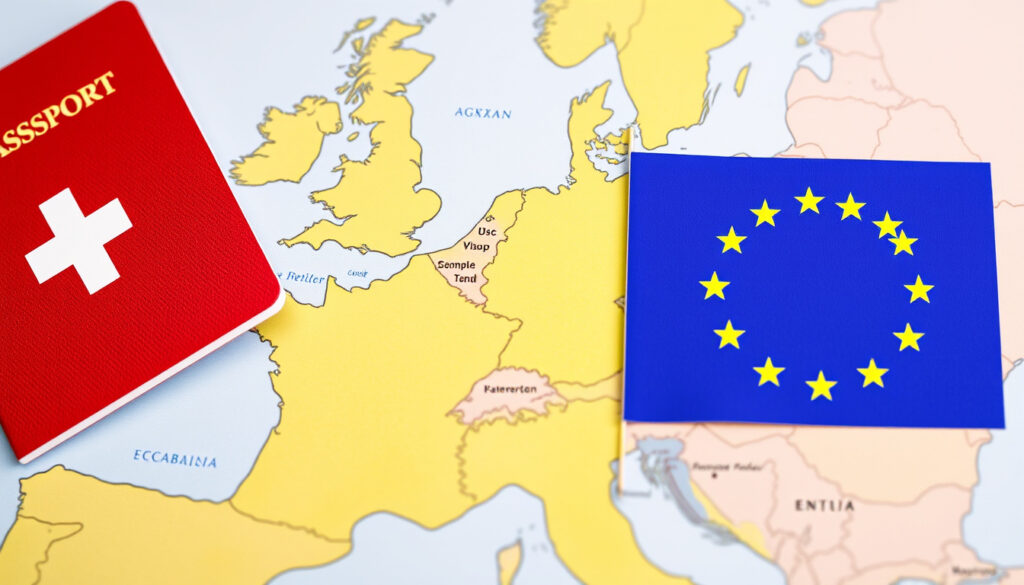
Is Switzerland in the EU? Status and Key Facts
Switzerland is not in the European Union, yet its relationship with the bloc is more integrated than many EU members. The country’s deliberate non‑membership paired with deep integration via bilateral treaties offers a unique model of European cooperation outside the EU framework.
EU membership status: Not a member ·
Joined Schengen: 2008 ·
Official currency: Swiss Franc (CHF) ·
Population: 8.7 million (2023) ·
Capital: Bern ·
Bilateral treaties with EU: Over 120 agreements
Quick snapshot
- Switzerland is not an EU member (Swiss Federal Administration)
- Switzerland uses Swiss franc (CHF) (Switzerland Tourism)
- Switzerland is in Schengen since 2008 (German Federal Foreign Office)
- Future of Swiss-EU framework agreement
- Whether Switzerland will ever join the EU
- 1992: Swiss voters reject EEA membership (Swiss Federal Administration)
- 2002: Switzerland applies for EU membership (Swiss Federal Administration)
- 2008: Joins Schengen (German Federal Foreign Office)
- 2016: Withdraws EU application (Swiss Federal Administration)
- 2025: New bilateral package proposed (FDFA)
- Optional referendum on 2025 bilateral package
- Continued negotiations on institutional framework
Six key facts, one pattern: Switzerland is deeply integrated with the EU without being a member.
| Fact | Value |
|---|---|
| EU member | No |
| Schengen member | Yes (since 2008) |
| Currency | Swiss Franc (CHF) |
| Capital | Bern |
| Population | 8.7 million (2023) |
| Official languages | German, French, Italian, Romansh |
Is Switzerland part of the EU?
No, Switzerland is not a member of the European Union in 2025, according to the Swiss Federal Administration. Instead, the country is linked to the EU through a broad package of bilateral agreements — over 120 treaties covering trade, transport, research, and more.
What is Switzerland’s relationship with the EU?
- Switzerland is part of the European Free Trade Association (EFTA), alongside Norway, Iceland, and Liechtenstein.
- It is not a member of the European Economic Area (EEA), unlike Norway and Iceland.
- Instead, Switzerland negotiates sector-specific bilateral agreements with the EU.
The implication: Switzerland gets access to the EU single market in selected areas without accepting full EU law or institutions.
Is Switzerland in the EEA?
No. Switzerland is not a member of the European Economic Area. The Swiss electorate rejected joining the EEA in a 1992 referendum, a decision that set the country on its bilateral path.
The trade-off: Switzerland avoids EU regulatory alignment in many sectors but must negotiate access piece by piece.
Why are the Swiss not in the EU?
Switzerland’s non-membership stems from a combination of direct democracy, neutrality, and economic sovereignty. The Swiss Federal Council has consistently cited these factors.
What are the main reasons for Swiss non-membership?
- Direct democracy: Major decisions go to public referendums, and Swiss voters have repeatedly rejected closer EU integration.
- Neutrality: Switzerland’s long-standing policy of neutrality makes full EU membership — which includes a common foreign and security policy — difficult.
- Economic concerns: Many Swiss fear that EU membership would require adopting the euro and accepting higher immigration levels.
How did Swiss voters reject EU membership?
- 1992: Voters reject joining the EEA.
- 2002: Switzerland applies for EU membership, but the application stalls.
- 2016: Switzerland formally withdraws its EU membership application.
The pattern: Swiss voters have consistently chosen bilateralism over membership, and the government has followed that mandate.
Switzerland is one of the EU’s closest partners — around 1.5 million EU citizens live and work in Switzerland, and 466,200 Swiss nationals live in the EU — yet it remains outside the political union.
Does Switzerland use the euro?
No. Switzerland’s official currency is the Swiss franc (CHF), as confirmed by Switzerland Tourism. The euro is not legal tender in Switzerland.
What is the official currency of Switzerland?
- The Swiss franc (CHF) is the sole official currency.
- It is also used in Liechtenstein and the Italian exclave of Campione d’Italia.
- The Swiss National Bank issues and manages the franc.
Can you use euros in Switzerland?
- Many tourist-oriented businesses accept euros, but at unfavorable exchange rates.
- Change is typically given in Swiss francs.
- As of 2025, the exchange rate is approximately 1 EUR = 0.94 CHF.
The catch: While euros are accepted in some places, relying on them will cost you more than using francs.
Is Switzerland part of Schengen?
Yes. Switzerland has been a member of the Schengen Area since 2008, according to the German Federal Foreign Office. This means passport-free travel between Switzerland and other Schengen countries.
When did Switzerland join Schengen?
- Switzerland signed the Schengen agreement in 2004 and implemented it in 2008.
- It participates in the Schengen Information System (SIS).
What does Schengen membership mean for Switzerland?
- No passport checks at borders with other Schengen states.
- Switzerland applies common Schengen visa rules for non-EU travelers.
- Swiss authorities cooperate with EU police and judicial systems on cross-border crime.
Why this matters: Schengen membership is one of the most visible benefits of Swiss-EU cooperation, making travel seamless for millions of tourists and residents.
Is Switzerland in the EU customs union?
No. Switzerland is not part of the EU customs union. It maintains its own customs border with the EU, according to the Swiss Federal Administration.
What are the customs arrangements between Switzerland and the EU?
- Switzerland has bilateral agreements that facilitate trade, including mutual recognition of industrial standards.
- Goods crossing the Swiss-EU border are subject to customs declarations and duties.
- Switzerland is not part of the EU’s common external tariff.
Does Switzerland have a customs union with the EU?
- No formal customs union exists.
- Switzerland has a free trade agreement with the EU dating back to 1972.
- Agricultural products and some services are not fully liberalized.
The trade-off: Switzerland avoids EU customs rules but faces more paperwork and costs for cross-border trade than EU members do.
In 2025, the Swiss Federal Council proposed a new bilateral package with the EU, including an optional treaty referendum. If approved, it could deepen ties further — but still stop short of membership.
Comparison: Switzerland vs. EU members vs. other non-members
Three categories, one key difference: Schengen membership does not require EU membership.
| Country | EU member | Schengen member | Currency | EEA member |
|---|---|---|---|---|
| Switzerland | No | Yes (2008) | CHF | No |
| Norway | No | Yes (2001) | NOK | Yes |
| Iceland | No | Yes (2001) | ISK | Yes |
| Germany | Yes | Yes | EUR | Yes |
| France | Yes | Yes | EUR | Yes |
| United Kingdom | No (left 2020) | No | GBP | No |
The implication: Switzerland’s position is unique among non-EU states, offering deep integration without political membership.
Pros and cons of Switzerland’s EU relationship
Upsides
- Maintains political sovereignty and neutrality
- Controls own immigration policy
- Keeps Swiss franc, avoiding eurozone crises
- Selective access to EU single market
Downsides
- No voting rights in EU decision-making
- Must negotiate each sector separately
- Faces customs barriers for goods
- Limited influence on EU regulations that affect it
The pattern: Switzerland’s bilateral approach provides sovereignty but limits influence in EU decision-making.
Timeline: Switzerland and the EU
- 1992: Swiss voters reject joining the European Economic Area. (Swiss Federal Administration)
- 2002: Switzerland applies for EU membership. (Swiss Federal Administration)
- 2008: Switzerland joins the Schengen Area. (German Federal Foreign Office)
- 2016: Switzerland withdraws its EU membership application. (Swiss Federal Administration)
- 2025: Swiss Federal Council proposes new bilateral package; Reuters reports broad support for deepening ties.
The pattern: Each step has deepened integration without crossing into membership.
Confirmed facts vs. what’s unclear
Confirmed facts
- Switzerland is not an EU member.
- Switzerland uses the Swiss franc (CHF).
- Switzerland is in the Schengen Area since 2008.
- Switzerland is not in the EU customs union.
- Switzerland has over 120 bilateral agreements with the EU.
What’s unclear
- The future of the Swiss-EU framework agreement — negotiations continue.
- Whether Switzerland will ever join the EU — current political consensus favors bilateralism.
The growth: Over 120 bilateral treaties show the depth of Swiss-EU cooperation despite non-membership.
Quotes from key sources
“Switzerland and the EU are linked by a broad package of bilateral agreements rather than EU membership.”
— Swiss Federal Administration
“The Swiss Federal Council adopted the ‘Swiss–EU relations’ package on 30 April 2025, with an optional treaty referendum.”
— Federal Department of Foreign Affairs (FDFA)
“Switzerland is one of the Schengen countries but not one of the EU countries.”
For travelers and businesses, the choice is clear: Switzerland offers seamless Schengen travel and deep economic ties with the EU, but without the political obligations of membership. Anyone crossing the border should carry Swiss francs, expect customs checks, and enjoy the best of both worlds.
axa-schengen.com, oanda.com, en.wikipedia.org, travelex.co.uk, newunionpost.eu, facebook.com
Frequently asked questions
Is Switzerland in the EU for data roaming?
No. Switzerland is not in the EU, so EU “roam like at home” rules do not apply. Mobile roaming charges may apply when traveling between the EU and Switzerland.
Does Switzerland have duty-free arrangements with the EU?
Yes, but limited. Switzerland is not in the EU customs union, so duty-free shopping applies for travelers between Switzerland and the EU, subject to allowances.
Is Switzerland part of NATO?
No. Switzerland is not a NATO member. It maintains a policy of neutrality and is not part of any military alliance.
Can I use euros in Switzerland?
Euros are accepted in many tourist areas, but at unfavorable exchange rates. The official currency is the Swiss franc (CHF).
How much is 100 euros in Swiss francs?
As of 2025, approximately 94 Swiss francs (1 EUR ≈ 0.94 CHF). Exchange rates fluctuate daily.
Which European countries are not in the EU?
Notable non-EU European countries include Switzerland, Norway, Iceland, Liechtenstein, the United Kingdom, and several Balkan states.
What is the difference between EFTA and the EU?
EFTA (European Free Trade Association) is a trade bloc focused on free trade, not political union. The EU has a single market, common policies, and supranational institutions. Switzerland is in EFTA but not the EU.
More related posts
 Paddy Power Open Now: Hours, App Fixes & 2026 Store Closures
 Best 7 Seater Cars Ireland: Top Family Picks 2024
 Wild Atlantic Way Ireland: Route & Planner
 West Pharma Share Price: Forecast, History, and Is It a Buy
 M&S Navan: Opening Hours, Phone, Discounts & Services (2025)
 Free Internet Speed Test Guide: Compare Top Tools
 Where to Watch Bluey: Disney+, RTE & ABC iview Guide
