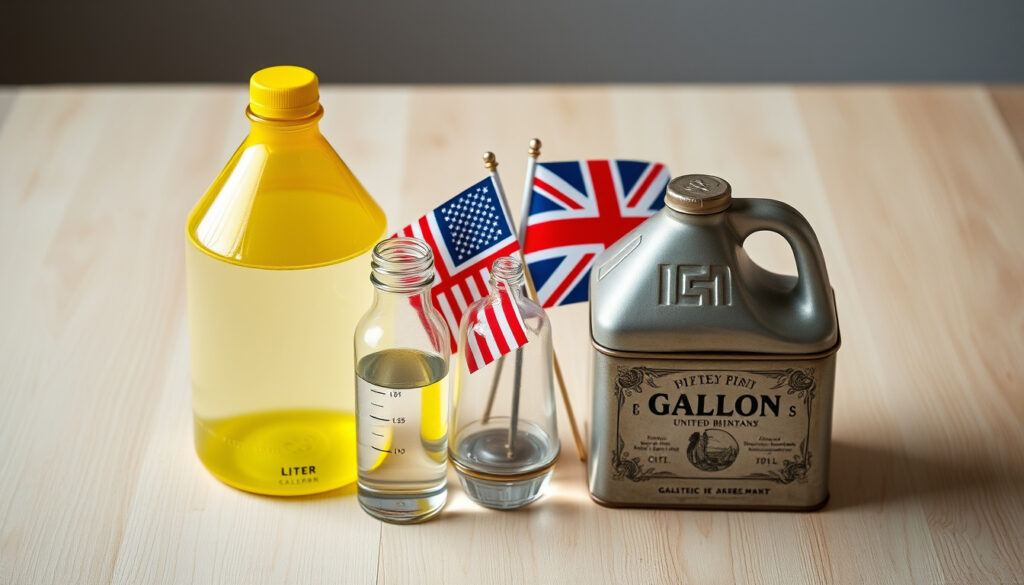
How Many Liters in a Gallon? US vs UK Conversion Guide
If you’ve ever tried to follow a recipe from a British cookbook while using American measuring cups, you already know the feeling: one gallon isn’t always one gallon. The difference between a US gallon and a UK gallon—nearly a full liter—has roots in a series of 19th-century legal decisions that still echo today. This guide lays out the exact numbers, the history behind the split, and the simplest way to convert between systems.
US liquid gallon in liters: 3.78541 L · Imperial (UK) gallon in liters: 4.54609 L · Difference: 0.76068 L (UK ≈ 1.201 US gallons) · 1 liter in US gallons: 0.26417 gal · 1 liter in UK gallons: 0.21997 gal
Quick snapshot
- 1 US liquid gallon = 3.78541 liters
- 1 UK imperial gallon = 4.54609 liters
- UK gallon is about 20% larger than US gallon
- Whether all former British colonies still use imperial gallon for certain measures
- 1824 – British Imperial Weights and Measures Act defines imperial gallon
- 1893 – US Mendenhall Order solidifies US gallon
- Check country of origin before converting gallons to liters
How many liters is a gallon in the UK?
The UK imperial gallon contains exactly 4.54609 liters. This definition was formalized by the 1824 British Weights and Measures Act, which set the imperial gallon as the volume of 10 pounds of water at 62°F (approximately 16.67°C). Unlike the US gallon, which traces its lineage to the older wine gallon, the imperial gallon was a deliberate standardization effort.
In 1965, the UK began its metrication program, but the imperial gallon remains legal for certain uses, particularly for selling fuel by the liter and beer by the pint. The UK gallon is about 20% larger than its US counterpart, a gap that matters in everything from grocery shopping to industrial bulk purchases.
The implication: when a British recipe calls for a gallon of stock, you’re adding 4.55 liters, not 3.79 liters—a full 760 mL difference that can tip a soup from rich to watery.
Are 4 liters equal to 1 gallon?
No—4 liters is not exactly equal to 1 gallon. Four liters equals approximately 1.057 US gallons or 0.880 UK gallons. That small-looking difference compounds quickly: over 5 gallons, the gap between the approximate “4 L ≈ 1 gal” rule and the true value exceeds 0.3 liters. For recipes, fuel, or any measured application, rounding this way introduces silent errors.
Use these exact figures instead: 4 liters = 1.0567 US gallons, and 4 liters = 0.8799 UK gallons. The numbers aren’t interchangeable, and the 20% difference between gallon types is far larger than most people expect.
The pattern: “about a liter” and “about a gallon” feel similar in everyday language, but the math falls apart the moment precision matters—which is why fuel stations and breweries never round this way.
Which is bigger, a gallon or a liter?
Both US and UK gallons are larger than a single liter. A US gallon holds 3.78541 liters, while a UK gallon holds 4.54609 liters. That means one US gallon is roughly the same as 3.8 standard 1-liter bottles, and a UK gallon would fill a 4.5-liter jug with a little room to spare. This difference is easy to miss when you see “gallon” alone on a label, especially since both systems use the same word for different volumes.
For a visual reference: picture a standard milk jug. A US gallon fills about 3.8 of those 1-liter bottles; a UK gallon fills about 4.5. The approximately 20% gap is the same difference as comparing a small bucket to a slightly larger one—noticeable only when you do the math.
The catch: any time a label just says “gallon” without specifying US or UK, you’re missing roughly a fifth of the actual volume. That’s not a rounding error; it’s a specification gap that can spoil a recipe or shortchange a fuel purchase.
US vs UK gallon comparison
| Attribute | US liquid gallon | UK imperial gallon |
|---|---|---|
| Liters (exact) | 3.78541 L | 4.54609 L |
| Legal definition | 231 cubic inches (US law) | 4.54609 L (1985 UK law) |
| Relative size | ≈ 0.833 imperial gallons | ≈ 1.201 US gallons |
| Common use | US fuel, milk, recipes | UK fuel (by liter), beer, some food |
The pattern: the US gallon is smaller, yet the US uses it for everyday measures like fuel and milk, while the UK has moved most trade to metric but kept the imperial gallon for certain products—meaning the risk of mix-ups lies in whatever system a given label uses.
How to convert gallons to liters (step by step)
Three steps, one rule: always identify which gallon you’re starting from.
- Identify the gallon type. Is it US liquid or UK imperial? Check the label, recipe, or source.
- Multiply or divide. For gallons to liters: multiply by 3.78541 (US) or 4.54609 (UK). For liters to gallons: divide by the same numbers.
- Round if needed. For everyday use, 3.79 (US) or 4.55 (UK) gives you accuracy within 0.1%.
If you only remember one thing: US gallon × 3.78541 = liters; UK gallon × 4.54609 = liters. A quick double-check—4 liters ≈ 1.06 US gallons, and ≈ 0.88 UK gallons—helps you catch sign errors before they turn into measurement mistakes.
The implication: these two multipliers aren’t approximations; they’re fixed legal definitions locked in by 19th-century law, which is why professional bakers and engineers treat them as non-negotiable constants rather than style-guide preferences.
Historical divergence of the gallon
Six milestones, one story: how a single unit split into two systems.
- 1824 – British Parliament passes the Weights and Measures Act, defining the imperial gallon as 10 lb of water at 62 °F (4.54609 L) (Wikipedia / Gallon).
- 1866 – The US formally adopts the wine gallon (231 cubic inches) in law, setting a US standard distinct from the imperial one.
- 1878 – The UK refines its standards with the Weights and Measures Act of 1878, reinforcing the imperial gallon.
- 1893 – The Mendenhall Order aligns US measurements with the metric system, fixing the US gallon at 3.785411784 liters exactly.
- 1965 – The UK begins metrication, gradually replacing gallon-based sales with liter-based measures, though the imperial gallon remains legal for certain transactions.
- 1985 – UK law codifies the imperial gallon as exactly 4.54609 liters for trade and measurement purposes.
The history of the gallon split begins with a messy set of regional measures. The imperial gallon was an attempt to unify them, but the United States had already adopted the wine gallon, and the two systems never reunited. That 19th-century fork in the road still determines whether your fuel purchase or cake recipe is off by a fifth.
What this means: the difference isn’t a quirk of measurement or a rounding preference—it’s a legal brick wall built twice, once in London and once in Washington, and it hasn’t moved since.
Expert perspectives on the gallon split
The imperial gallon was an attempt to unify older British liquid measures such as wine and ale gallons. The US had already adopted the wine gallon, so the two systems never reunited.
The US and UK gallons are different units separated by a 0.76-liter gap—a 20% difference that matters in fuel, cooking, and commerce. The simplest rule: always check the country of origin.
Related reading: **162 cm in Feet: Exact Conversion & Height Guide**
en.wikipedia.org, scienceinsights.org, wikidoc.org, thecalculatorsite.com, footflyer.com, engconvert.com, en.citizendium.org, fr.wikipedia.org, calcstation.com, unitflow.net, unitmaster.app