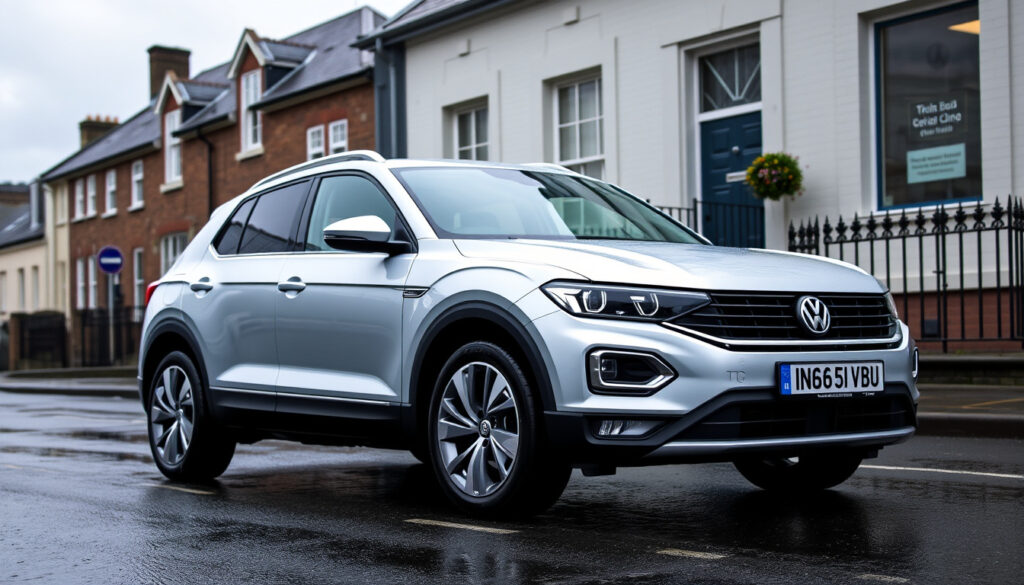
Volkswagen T-Roc 2026 Review: Specs, Problems & Irish Prices
If you’re weighing up a small SUV in Ireland, the Volkswagen T-Roc keeps popping up in conversations for a good reason. It blends the elevated driving position buyers want with a surprisingly premium cabin, but questions about reliability and whether it’s better value than a Tiguan or Golf are unavoidable. This guide uses real Irish market figures, owner-reported faults, and direct comparisons to help you decide if the T-Roc is the right car for your budget.
Starting price (Ireland, approx.): €33,000 for 1.0 TSI ·
Engine options: 1.0L, 1.5L, 2.0L petrol; 2.0L diesel ·
Boot space: 445 litres ·
Top speed (1.5 TSI): 128 mph (206 km/h) ·
Fuel economy (best diesel): up to 60 mpg (4.7 L/100km)
Quick snapshot
- Euro NCAP 5-star rating (Euro NCAP)
- Boot capacity 445 litres (VW Ireland official)
- Dimensions: length 4.24 m, wheelbase 2.59 m (VW technical data)
- Exact resale value after 3 years in Ireland — varies by model and mileage
- Long-term reliability data beyond 5 years limited to forum reports
- DPF issue frequency on modern diesels not officially quantified
- 2018 recall: electro-mechanical park brake (WhoCanFixMyCar)
- 2019 recall: faulty rear spoiler bonding (WhoCanFixMyCar)
- 2022 recall: engine compartment covers (WhoCanFixMyCar)
- Facelifted model (2022 onward) with improved cabin quality
- Potential electrified T-Roc variant expected later in the decade
- Used prices on DoneDeal likely to soften as more stock arrives
Six key facts every Irish buyer should have at hand before visiting a dealer.
| Specification | Value |
|---|---|
| Starting price (new, Ireland) | €33,000 (1.0 TSI Life) |
| Boot capacity | 445 litres (VDA) |
| Available engines | 1.0 TSI, 1.5 TSI, 2.0 TSI, 2.0 TDI |
| CO2 emissions range | 128-152 g/km (WLTP) |
| Euro NCAP rating | 5 stars (2019) |
| Average used price on DoneDeal | €16,000-€22,000 |
The span between new and used is wide enough that a well-specced 3-year-old T-Roc could save you nearly €15,000 — a serious factor if you’re flexible on model year.
Is the VW T-Roc worth buying?
Price and value for money in Ireland
- New entry price in Ireland lands at roughly €33,000 for the 1.0 TSI Life trim — cheaper than a base Tiguan by about €4,000 but pricier than a comparable Golf by a few hundred (VW Ireland).
- On the used market, DoneDeal listings show 2019-2021 models with 30,000-60,000 km priced between €16,000 and €22,000, making it a strong candidate for buyers who want a small SUV without the new-car premium.
- Diesel variants (2.0 TDI) command a €2,000-€3,000 premium over equivalent petrols on both new and used markets, though the fuel savings repay that gap over about 30,000 km of annual driving.
An Irish buyer who covers 20,000 km/year on motorways will recoup the diesel premium in fuel cost within two years; a buyer doing only urban short trips is better off with the 1.0 TSI.
Pros and cons summary
Upsides
- Premium-feeling cabin with quality materials (Motorpoint)
- Assertive styling that stands out from conservative Golf
- Good real-world fuel economy: 1.0 TSI averages 50 mpg
- 5-star Euro NCAP safety rating
Downsides
- Above-average reliability complaints (VW ranked 27th of 31 in Carwow’s Driver Power 2025)
- DSG gearbox can feel jerky at low speeds
- Rear seat room is adequate but not class-leading
- Warranty only 3 years / 60,000 miles
The pattern: the T-Roc wins on style and cabin polish, but its ownership costs are shadowed by reliability reports that trail rivals like the Toyota C-HR. For buyers who keep a car for three years under warranty, the pros outweigh; for those planning to run it past five years, the trade-off is real.
What is the most common problem with the VW T-Roc?
Electrical system faults
- Multiple owner reports on forums and garage networks cite electrical glitches as the most frequently encountered issue. The start-stop system is a common failure point, often requiring a software reset (Autodoc).
- The electro-mechanical park brake triggered a formal recall in 2018 (R/2018/301) after reports that it could release inappropriately (WhoCanFixMyCar).
- Inductive phone charging pads and keyless entry sensors have also generated sporadic “not working” complaints among Irish owners on forums.
Infotainment screen issues
- The standard 8-inch touchscreen suffers from freezes and random reboots, particularly in colder months when the car’s interior has just been de-iced (Top Gear).
- Wireless Apple CarPlay and Android Auto are supported, but the system’s response lag has been noted as sub-par compared to the equivalent system in a Golf or Tiguan.
- In the 2022 facelift model, VW updated the software architecture, which reportedly improved stability — but early-build cars (2017-2020) remain the best candidates for glitches.
Engine problems on early models
- Petrol 1.0 and 1.5 TSI engines can exhibit a ‘kangaroo’ jerking during cold starts in winter. VW issued a software patch but many owners say it did not fully resolve the problem (WhoCanFixMyCar).
- DSG gearboxes, fitted to mid-range and up, show jerky low-speed shifting and delayed engagement after 15,000-25,000 km (Autodoc). A DSG fluid change every 40,000 miles is strongly recommended to mitigate this.
- Diesel 2.0 TDI engines have been reported to clog their DPF filters when used primarily on short urban routes — something Irish buyers on the N40 or M50 less frequently but those in town-heavy commutes will face.
The T-Roc’s most common faults are electrical and DSG-related, neither of which is a showstopper under warranty. But for a buyer buying a 5-year-old car privately, those same issues can cost €500-€1,500 each to rectify at a VW specialist.
Is T-Roc better than Tiguan?
Four dimensions that tell the story of which VW SUV fits your life.
| Dimension | T-Roc | Tiguan | Difference |
|---|---|---|---|
| Length | 4.24 m | 4.52 m | +28 cm to Tiguan |
| Wheelbase | 2.59 m | 2.68 m | +9 cm to Tiguan |
| Boot capacity (seats up) | 445 L | 615 L | +170 L to Tiguan |
| Rear legroom (approx.) | 850-900 mm | 900-960 mm | Tiguan roomier |
The Tiguan offers notably more boot space and rear passenger room. If you regularly carry four adults or a buggy and a large shopping load, the Tiguan justifies its higher price.
Engine and performance differences
- Both share the same engine family (1.5 TSI and 2.0 TDI), but the Tiguan is heavier by ~150 kg, so the 1.5 TSI feels more energetic in the lighter T-Roc.
- 0-100 km/h times: T-Roc 1.5 TSI (8.3 sec) vs Tiguan 1.5 TSI (9.2 sec) — the T-Roc’s lower kerb weight gives it a clear acceleration edge (VW technical data).
- Fuel economy is nearly identical in real-world driving; expect 47-50 mpg from either with the 1.5 TSI.
Price difference in Ireland
- A new T-Roc 1.0 TSI Life starts at €33,000; a comparable Tiguan 1.5 TSI Life is around €37,000 — a €4,000 gap that shrinks to about €2,500 on mid-spec trims.
- On the used market (3 years old, 40,000 km), T-Rocs average €18,000-€21,000 while Tiguans sit at €22,000-€27,000 (DoneDeal listings).
What this means: the T-Roc delivers the same powertrain and VW quality in a smaller, lighter, cheaper package. The Tiguan pays for itself only if you genuinely need the extra space — otherwise the T-Roc is the sharper choice on price and agility.
Is a T-Roc bigger than a Golf?
Dimensions compared
- Length: T-Roc (4.24 m) is actually 7 cm shorter than the standard Golf (4.31 m) — surprising given the SUV stance.
- Height: T-Roc sits 1.58 m tall vs Golf’s 1.48 m, giving an SUV-like 10 cm ride height advantage that improves visibility and entry/exit.
- Width: Nearly identical (1.81 m for T-Roc vs 1.79 m for Golf).
Boot space measurement
- T-Roc: 445 litres (VDA) — expands to 1,290 L with seats folded.
- Golf: 380 litres — expands to 1,237 L.
- The T-Roc offers 65 litres more boot space — roughly an extra small suitcase or weekly shop.
- Both have low loading lips and 60:40 split rear seats.
Rear seat room
- Knee room in the back is comparable — the Golf’s longer wheelbase (2.61 m vs T-Roc’s 2.59 m) gives a slight edge to the hatchback.
- Headroom: T-Roc wins comfortably due to the higher roofline; average 5-7 cm more clearance for rear passengers.
- Practical outcome: A 6-foot adult in the rear of a Golf brushes the roofliner; in the T-Roc, the same passenger has a couple of centimetres to spare.
What car is equivalent to a VW T-Roc?
Six market alternatives, one pattern: the T-Roc competes in the compact SUV segment, where rivals offer similar size and price but different strengths.
| Model | Starting price (new, Ireland) | Boot space | Engine range |
|---|---|---|---|
| VW T-Roc | €33,000 | 445 L | 1.0-2.0 TSI, 2.0 TDI |
| Hyundai Kona | €31,500 | 407 L | 1.0 T-GDI, 1.6 T-GDI, EV |
| Kia Seltos | €29,950 | 433 L | 1.5 GDi, 1.4 T-GDi |
| Ford Puma | €28,500 | 456 L | 1.0 EcoBoost |
| Nissan Juke | €28,900 | 422 L | 1.0 DIG-T mild hybrid |
| Toyota C-HR | €35,000 | 377 L | 1.8 hybrid, 2.0 hybrid |
The implication: the T-Roc sits near the top of the price bracket but offers the best boot space and widest engine choice. The Toyota C‑HR for Sale in Ireland — a direct rival — starts higher, has less boot room, but beats the T-Roc on reliability and hybrid fuel economy.
Pricing comparison
- The T-Roc’s €33,000 entry sits between the premium-compact C-HR (€35,000) and the value-for-money Kia Seltos (€29,950).
- On the used market (3 years old), the T-Roc holds value relatively well: typical depreciation is 35-40% over three years, similar to the Kona and slightly better than the Nissan Juke.
- The Ford Puma undercuts the T-Roc by €4,500 new and offers a more playful drive but lacks the premium cabin feel of the VW.
For an Irish buyer on a budget up to €30,000, the Kia Seltos and Ford Puma deliver more metal for the money. For someone who values interior quality and a strong engine lineup, the T-Roc remains the reference in this segment.
What’s unclear about the T-Roc’s long-term picture
Confirmed facts
- T-Roc dimensions from VW official specs
- Prices for new cars from VW Ireland website
- Euro NCAP 5-star rating
- Boot capacity 445 litres
What’s unclear
- Exact resale value after 3 years in Ireland — varies by model
- Long-term reliability data beyond 5 years limited
- DPF issue frequency on modern diesels — not officially quantified
What reviewers say about the T-Roc
The T-Roc has always been one of the more spacious small SUVs — you get decent room in the back and a boot that’s genuinely useful.
It’s a refined and premium-feeling small SUV that manages to stand out from the Golf without compromising practicality.
Electrical issues are the most reported problem on the T-Roc — from start-stop failures to infotainment freezes, owners flag these as regular frustrations.
The consensus from reviewers paints a clear picture: the T-Roc delivers on design and space, but ownership reality is tempered by reliability headaches that rival brands like Toyota and Kia simply don’t have at this price point.
Related reading: **Toyota C‑HR for Sale in Ireland** · **Best 7 Seater Cars Ireland**
Frequently asked questions
What engine should I choose for the VW T-Roc?
For most Irish buyers, the 1.5 TSI petrol is the sweet spot — enough power for motorway cruising (0-100 km/h in 8.3 sec) while returning 47 mpg in real-world driving. The 2.0 TDI diesel is only worthwhile if you cover over 20,000 km per year on longer runs.
Does the VW T-Roc have 4WD?
Yes, the 2.0 TSI and 2.0 TDI engines are available with 4MOTION all-wheel drive. The 1.0 TSI and 1.5 TSI are front-wheel drive only.
What is the service interval for a T-Roc?
VW recommends annual servicing or every 20,000 km — whichever comes first. DSG fluid must be changed every 40,000 miles (64,000 km) to avoid jerky gear changes (WhoCanFixMyCar).
How much is road tax on a VW T-Roc in Ireland?
Based on WLTP CO2 emissions (128-152 g/km), annual road tax ranges from €270 to €420 depending on the exact engine and year.
Is the T-Roc reliable for long distance driving?
Generally yes — the T-Roc is comfortable and well-suited to motorway journeys. The 1.5 TSI is smooth at cruise; the 2.0 TDI delivers excellent range (over 800 km on a tank). Ensure DSG fluid is up to date for reliable gear changes on long climbs.
Can I fit a child seat in the back of a T-Roc?
Yes, there are ISOFIX points on both outer rear seats. A rear-facing child seat will require the front passenger seat to be moved forward a bit, but the 445-litre boot accommodates a stroller plus shopping with ease.
Does the T-Roc have Apple CarPlay and Android Auto?
Yes, from the 2019 model year onward the standard 8-inch infotainment screen supports wireless Apple CarPlay and Android Auto. Pre-2019 models require a wired connection but include the feature.
The T-Roc is a genuinely appealing small SUV with an upmarket cabin and a comprehensive engine range. But its reliability track record — particularly with the DSG gearbox and electrical systems — demands caution. For an Irish buyer who leases or finances over three years with a full warranty, the T-Roc is a stylish and practical choice. For a buyer planning to keep a car for seven or eight years and run it without dealer backing, the smart money goes on a Toyota C-HR or a Kia Seltos with its longer warranty. The choice is clear: the T-Roc is the better SUV to drive, but it’s not the better car to own long-term.
More related posts
 Drugs Payment Scheme Card: Apply, Renew & Save on Prescriptions
 Cast of Django Unchained (2012): Roles, Actors & Oscar Winners
 Django Unchained Cast: Actors, Characters, and Trivia
 Taylor vs Serrano 3 Results: Winner, Time, Stats & Purse
 The Line Saudi Arabia: 2026 Status, Cost & Scale-Back
 Shilajit Benefits for Females: Dosage, Side Effects & Comparisons
 Buy to Let Mortgage Ireland 2025: Rules, Rates & Requirements
 At The Races Quick Results: Fast Horse Racing Today
