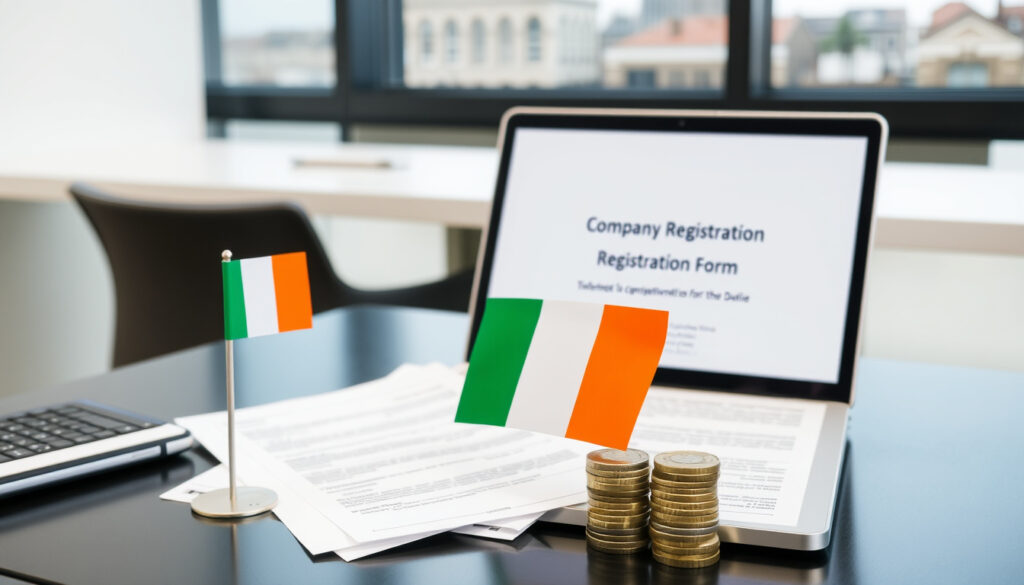
Setting Up a Company in Ireland: Costs, Steps, and Requirements
Anyone who has looked into starting a business in Ireland quickly discovers that the process is simpler than many expect—once you know exactly which forms to fill and which fees to pay. Whether you are a resident or a non-EEA founder, the country’s corporate registry (CRO) has a clear online path that typically costs €100 and takes about 3–5 working days, and this guide walks through every cost, requirement, and step you need to get your limited company up and running, including what the much‑discussed 183‑day rule actually means for your tax status.
Registration fee (CRO): €50 name reservation + €50 incorporation ·
Standard processing time: 3–5 working days ·
Minimum directors required: At least one (EEA resident or bond required for non-EEA) ·
Tax residency trigger (183-day rule): 183 days in a single tax year
Quick snapshot
- CRO registration fee is €100 (€50 name reservation + €50 incorporation) (Businesses.ie – business compliance guide)
- Standard incorporation takes 3–5 working days (Businesses.ie)
- Director must be EEA resident unless a Section 137 bond is posted (Forti – Irish company formation for non‑residents)
- Exact processing time when documents are incomplete or the name is rejected – CRO doesn’t publish averages for resubmissions (Forti)
- Cost of a Section 137 bond varies by provider (€1,500–€2,000 estimate from one formation firm) (Forti)
- Bank account opening timelines for non‑resident directors – some digital banks approve in days, traditional banks in weeks (Forti)
- Name reservation: instant online
- Incorporation filing (online): 3–5 working days (Businesses.ie)
- Register for Corporation Tax, VAT (if turnover exceeds €37,500/€75,000), and PAYE (Nathan Trust – corporate services)
- Open an Irish business bank account (Nathan Trust) (Nathan Trust – corporate services)
- File first annual return (B1) within 6 months of incorporation (Businesses.ie) (Nathan Trust – corporate services)
Here are the key numbers every founder should know.
| Metric | Value |
|---|---|
| Minimum cost to register | €100 |
| Processing time | 3–5 working days |
| Director requirement | At least one (EEA resident or bond) |
| Tax residency trigger | 183 days in a tax year |
What is the cost of setting up a company in Ireland?
Registration fee breakdown at CRO
- Name reservation: €50 – paid online via CRO’s CORE system. The name is held for 28 days.
- Incorporation filing: €50 – using the online route, which is cheaper than the paper‑based filing at €100. Total: €100.
The €100 figure is confirmed by the Companies Registration Office (via Businesses.ie, a compliance portal). An additional €25 is charged for a name reservation if you file separately, but the standard online flow combines both steps for €100.
Additional costs: company secretary, registered address, legal fees
- Company secretary: Many formation agents include this for €50–€150 per year. You can appoint yourself or a director, but non‑residents often need a paid service.
- Registered address: A virtual office address in Ireland costs about €100–€300 annually.
- Legal fees for constitution: Standard formation agents charge €100–€300 for a full package including the constitution and Form A1. Binderr (company formation marketplace) estimates a simple DIY setup at €200–€600, with complex non‑resident setups potentially exceeding €5,000.
Ongoing costs: annual returns, audit fees
- B1 annual return filing: €20 online each year (Businesses.ie).
- Audit fees: Companies with turnover over €12 million or employees over 50 generally need an audit. Smaller companies can claim audit exemption. Annual accounting costs start around €1,500 for a small company.
Bottom line: The minimum one‑off outlay is €100 to the CRO plus €100–€300 for a formation agent. Non‑resident founders face an additional €1,500–€2,000 for the Section 137 bond. Budget‑conscious residents: DIY online filing via CORE. Non‑resident founders: factor in the bond and a paid company secretary.
The pattern: residents pay the least upfront, while non‑residents must add bond and address costs.
What do you need to set up a company in Ireland?
Minimum requirements for a limited company
- At least one director (no maximum, but at least one must be an EEA resident unless a bond is posted).
- One company secretary (can be a director, but not the sole director if there is only one director).
- At least one shareholder (can be the same person as the director).
- A registered address in Ireland (PO Box not allowed).
- Company name approved by the CRO.
Documents required for incorporation
- Form A1 (application for incorporation, signed by subscribers).
- Company constitution (two documents: memorandum and articles of association, or a single constitution under the 2014 Act).
- Statement of capital and initial shareholdings.
- Name reservation confirmation (if reserved separately).
All documents are filed through the CRO’s online portal. The Open Forest (company formation service) notes that a qualified company secretary is required, and the registered office must be a physical Irish address.
Appointing a company secretary and director
You can appoint any individual over 18 as secretary, but they must be willing to accept responsibilities. Non‑residents who cannot supply an EEA‑resident director must arrange a Section 137 bond – effectively an insurance policy that guarantees the company’s compliance. Forti’s 2026 guide for non‑residents estimates the bond premium at €1,500–€2,000.
A non‑resident founder faces a trade‑off: pay the bond and a virtual office address, or find a local EEA‑resident director. That director must be a real person with a verifiable address – not a nominee shell.
The implication: non‑residents must budget for either the bond or the cost of finding a qualified director.
How to Set Up a Limited Company in Ireland (Step by Step)
-
Step 1: Choose a company name and check availability
Search the CRO’s name database online. The name must not be identical or too similar to an existing company. Reserve your chosen name for €50 through CORE – it lasts 28 days.
-
Step 2: Appoint directors, secretary, and shareholders
You need at least one director and one secretary. Shareholders can be individuals or corporate entities. If you are the sole director/shareholder, you must still appoint a separate secretary.
-
Step 3: Submit incorporation application to CRO
File Form A1 and the company constitution through CRO’s online system. The online filing fee is €50 (total €100 including name reservation). Standard processing is 3–5 working days. Nathan Trust (corporate services firm) describes this as a six‑step flow that also includes tax registration.
-
Step 4: Register for taxes
- Corporation Tax: Register with Revenue within 30 days of starting to trade. The rate is 12.5% on trading income.
- VAT: Register if turnover exceeds €37,500 (services) or €75,000 (goods). You can voluntarily register earlier.
- PAYE: If you hire employees (including yourself as a director drawing a salary), register for payroll.
-
Step 5: Open a business bank account
Irish banks require the company’s Certificate of Incorporation, constitution, and proof of registered address. Non‑residents may need additional ID checks. Allow 1-2 weeks for the account to open.
Company Formations (specialist provider) confirms the entire process can be handled remotely without visiting Ireland – including tax registration and bank account opening through international services.
Do I need an accountant if I’m a limited company?
Legal requirement vs practical advice
There is no law requiring you to hire an accountant. However, the Companies Act 2014 demands annual returns and financial statements. Revenue requires Corporation Tax returns and payroll submissions. Most founders find an accountant saves time and prevents penalties.
What an accountant can do for a limited company
- Prepare and file annual B1 return (€20 filing fee, but accountant’s fee for preparing accounts is typically €1,000–€2,500).
- Submit Corporation Tax returns (CT1) and manage tax payments.
- Handle VAT returns and payroll (PAYE) if you have employees.
Potential costs of not using an accountant
Late filing of the annual return triggers a penalty of €100 for the first late filing, rising to €1,500 for persistent delinquency. Errors in tax filings can lead to Revenue audits and interest charges. Businesses.ie lists the B1 online fee at €20, but the real cost of non‑compliance is far higher.
A DIY director saves €1,000‑plus annually on accountancy fees, but risks penalties and missed deductions. For a non‑resident director juggling multiple countries, the cost of an accountant is usually less than the headache of Irish compliance.
The catch: what you save in fees you might lose in penalties or missed tax relief.
What is the 183 day rule in Ireland?
Definition of tax residency in Ireland
You are Irish tax resident in a tax year if you spend 183 days or more in Ireland in that year. This is the 183‑day rule, set out by Revenue. Days of arrival and departure both count, and short visits can add up quickly.
How the 183‑day rule applies to company directors
A non‑resident director who attends board meetings in Ireland, works from an Irish office, or spends significant time in the country may become tax resident. That means worldwide income becomes taxable in Ireland – not just the director’s salary from the Irish company. Nathan Trust advises non‑resident directors to track their days carefully.
Interaction with the 50/50 rule for non‑residents
Even if you don’t hit 183 days in a single year, you can become resident under the 50/50 rule: if you spend at least 30 days in Ireland in a tax year and your total days across the current year and the previous year add up to 280 or more, you are resident for the current year. This prevents avoidance by splitting time across borders.
Why this matters: A non‑resident founder who spends 140 days each year in Ireland for two years will be tax resident for year two – without ever crossing 183 days in one year.
How long does it take to set up a limited company in Ireland?
Standard CRO processing time
Online incorporation through CORE takes 3–5 working days from the moment the documents are correctly submitted. A name reservation is instant.
Factors that can delay registration
- Name conflicts: if the name is too similar to an existing company, you must choose another and pay the reservation fee again.
- Incomplete or incorrect Form A1: missing signatures or wrong share structure details.
- Constitution drafting errors: modern constitutions under the 2014 Act are straightforward, but any mistake requires a fresh submission.
Expedited options
The online route is already the fastest. No premium expedited service exists at the CRO – but using a formation agent (who checks documents before filing) often reduces rejection rates, saving a week of back‑and‑forth. DLA Piper’s global expansion guide notes that branch registrations must be filed within 30 days of establishment, but standard company incorporation has no statutory deadline – just your own need to start trading.
Bottom line: Budget one week from start to Certificate of Incorporation, two weeks if you need a Section 137 bond. Resident founders: prepare documents in one day, file Tuesday, get certificates by Friday. Non‑resident founders: add two weeks for bond negotiation and virtual address setup.
The pattern: the fastest route is online DIY, but non‑residents should expect a longer timeline due to bond and address arrangements.
DIY vs Formation Agent: What’s the real difference?
Six costs, one pattern: going direct to the CRO saves money but demands more of your time and knowledge. Paying a formation agent adds upfront cost but reduces risk.
| Item | DIY via CRO CORE | Formation agent (full service) |
|---|---|---|
| Name reservation | €50 | Included in package |
| Incorporation fee | €50 | Included |
| Company secretary | You find one – cost €0–€150/yr | Often included for first year |
| Registered address | You arrange – €100–€300/yr | Often included for first year |
| Constitution & Form A1 | Free templates available | Drafted by professionals |
| Total upfront cost | €100–€450 | €200–€600 (some packages start at €250) |
| Processing time | 3–5 days (may be longer if rejected) | 3–5 days (agents pre‑check docs) |
| Risk of rejection | Moderate (if you miss details) | Low |
Sources: CRO fee schedule via Businesses.ie; agent packages from Binderr and Company Formations.
The trade-off: paying more upfront reduces administrative burden and rejection risk.
Pros and cons of setting up a limited company in Ireland
Upsides
- Low Corporation Tax (12.5% on trading income) – one of the most competitive rates in Europe.
- Separate legal entity protects personal assets.
- Can be registered entirely online – no physical presence needed for most founders.
- Access to double‑taxation treaties and the EU single market for services.
Downsides
- Annual compliance burden – B1 returns, financial statements, and Corporation Tax filings.
- Non‑resident directors face Section 137 bond costs (€1,500–€2,000) and must appoint a company secretary.
- Audit exemption thresholds exist but are stricter than in the UK – many small companies still need an accountant.
- Personal tax residency can be triggered by a 183‑day stay, catching unsuspecting directors.
The pattern: the benefits of incorporation are clear for many, but non‑residents must weigh the extra bonding and compliance costs.
Clarity: What’s confirmed, what’s still uncertain
Confirmed facts
- CRO registration fee: €50 name reservation + €50 incorporation = €100.
- Standard processing: 3–5 working days.
- 183‑day rule for personal tax residency.
- B1 annual return fee: €20 online.
What’s unclear
- Exact time for non‑standard applications or name rejections – CRO does not publish failure rates.
- Cost of the Section 137 bond for non‑EEA directors – varies by provider (reported range €1,500–€2,000).
- Bank account opening timelines for non‑resident directors – some digital banks approve in days, traditional banks in weeks.
- Exact penalties for late filing vary by duration and can be found in the FAQ below.
Expert perspectives on Irish company formation
“Reservation of a company name costs €50 and can be done online through the CRO’s CORE system. The online incorporation fee is €50, making the total government cost €100.”
— Companies Registration Office guidance (via Businesses.ie)
“You are resident for a tax year if you spend 183 days or more in Ireland in that year. This applies equally to company directors and employees.”
“A non‑resident director who cannot secure an EEA‑resident co‑director must arrange a Section 137 bond. We estimate the annual premium at €1,500–€2,000.”
— Forti – Irish company formation specialists
“The entire company formation process can be completed remotely without setting foot in Ireland – including tax registration and bank account opening.”
Related reading: Mason Hayes & Curran: Leading Irish Business Law Firm
Summary: What every founder should take away
Setting up a limited company in Ireland is a low‑cost, quick process for residents: €100 and 3–5 days to get a Certificate of Incorporation. The real cost is in the ongoing compliance – annual returns, Corporation Tax filings, and, for non‑resident founders, a Section 137 bond. The 183‑day rule adds another layer of tax complexity that many entrepreneurs underestimate. For a non‑resident founder with no EEA ties, the decision is clear: budget €2,000–€2,500 for the first year (bond + agent fees + virtual address), or find an EEA‑resident director to avoid the bond entirely – and track every day you spend in Ireland to avoid an unexpected tax bill.
forti.ie, youtube.com, remitly.com, youtube.com, openforest.co, youtube.com
Understanding the limited company structure in Ireland is essential before navigating the specific registration steps and tax obligations for non-EEA residents.
Frequently asked questions
What is the difference between a sole trader and a limited company in Ireland?
A sole trader is personally liable for all debts and pays income tax on profits. A limited company is a separate legal entity with limited liability, pays Corporation Tax (12.5%), and must file annual returns with the CRO.
What are the ongoing annual obligations for a limited company?
You must file an annual return (B1) with the CRO each year (€20 online), submit financial statements, pay Corporation Tax and VAT (if registered), and maintain a company register. Penalties apply for late filing.
Do I need to register for VAT immediately after incorporation?
No – only when your taxable turnover exceeds €37,500 for services or €75,000 for goods. You can voluntarily register earlier to reclaim VAT on expenses.
Can a non‑EEA resident be a director of an Irish company?
Yes, but only if the company posts a Section 137 bond (annual premium €1,500–€2,000) to guarantee compliance. Alternatively, appoint an EEA‑resident co‑director.
What is the penalty for late filing of annual returns?
Late filing within 30 days: €100. After 30 days: €500. After 3 months: €1,500. The company may also be struck off the register for persistent non‑filing.
How do I change the registered address of my company?
File a Form B7 with the CRO (€15 online). The new address must be a physical location in Ireland. Notify Revenue, your bank, and any other stakeholders.
Is it possible to set up a company in Ireland without a physical office?
Yes – you can use a virtual office or registered address service. The address must be a real street address in Ireland where legal documents can be served. A PO Box is not allowed.
More related posts
 What Time Is It in Melbourne? Current Time & Time Zone
 Top of the Rock: Is It Worth It? How Long to Spend? vs Empire State
 Ryanair Flights to Malaga: Cheap Fares & Tips
 Taylor vs Serrano 3 Results: Winner, Time, Stats & Purse
 Best Bicycle Shop Near Me in Dublin | Find Local Bike Shops
 What Is Sharia Law? Rules, Punishments, and Global Impact
 Nest of Tables Ireland: Where to Buy, Types & Buying Guide
 SpongeBob Tower Defense Codes: Active List for June 2026
