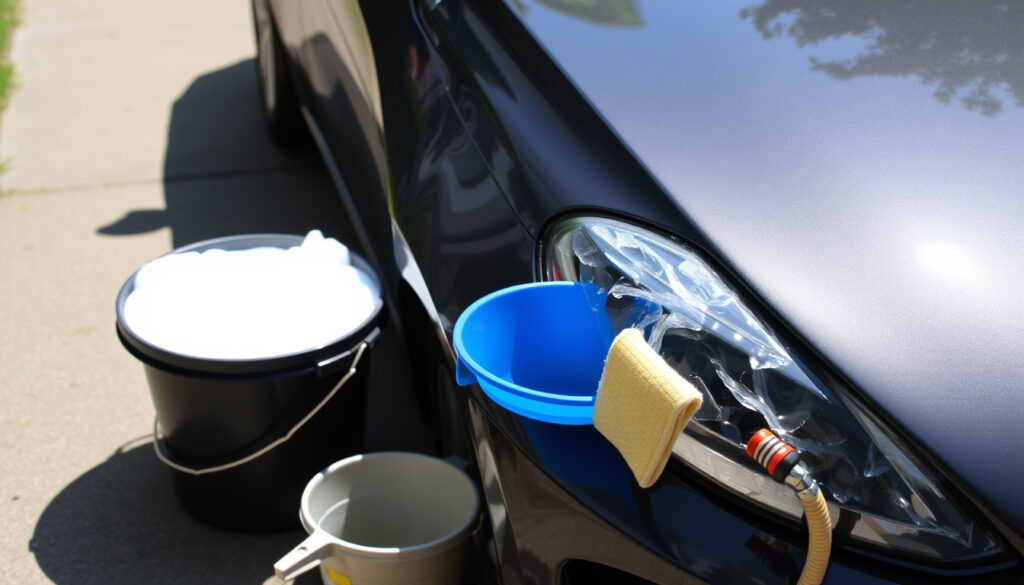
How to Wash a Car Properly with Two-Bucket Method
There’s nothing quite like a freshly washed car — that shine catches light in a way that makes even a daily driver feel like something worth caring about. But the gap between “hose it down and call it done” and what your paint actually deserves is wider than most people realize. The two-bucket method, borrowed from professional detailers, takes a little more time but keeps swirl marks off your finish, and you can run the whole operation from a shaded driveway with supplies from any auto shop. Here’s how to do it right.
Buckets needed: 2 · Start washing from: top of car · Rinse method: plain water bucket · Wash motions: straight lines · Park location: shaded area
Quick snapshot
- The two-bucket method prevents swirl marks and scratches on paintwork (Rocket Carwash)
- Grit guards or dirt traps at bucket bottoms trap debris and prevent reintroduction to the wash mitt (Rocket Carwash)
- Wash bucket: 1–3 oz of car wash soap per 5 gallons of water (Glass Transparency)
- Optimal water temperature for wash and rinse buckets lacks definitive guidance
- How frequently to change rinse bucket water during a full wash is not standardized
- Exact homemade car wash recipes remain inconsistent across sources
- Two-bucket method established as a professional washing standard in the 2000s–2010s
- YouTube tutorials made the technique accessible to home users through the 2010s
- Commercial two-bucket kits with grit guards became standard retail products by 2020
- Rinseless wash methods have emerged as a water-efficient alternative
- Foam cannons reduce the necessity of two-bucket washing for some users
- DIY home washing continues growing as consumers avoid professional detailing costs
The key parameters for the two-bucket method are summarised in the table below.
| Label | Value |
|---|---|
| Ideal parking | Shaded area |
| Bucket setup | One soapy, one rinse |
| Motion type | Straight lines |
| Foam dwell | 10 minutes |
| Rinse bucket contents | Clean water only, no soap |
| Drying material | High-quality microfiber towels |
How do you correctly wash a car?
The correct approach to washing a car centers on contamination control — keeping dirt and grit away from your wash mitt so it never grinds across your paint. The two-bucket method (one bucket filled with soapy water, one with plain rinse water) is the technique professional detailers rely on for exactly this reason. According to Rocket Carwash, the primary objective is to prevent swirl marks and scratches on vehicle paintwork.
Start from the top
Always begin at the roof and work your way down. Gravity pulls dirt and soap toward the lower sections, so starting at the top means each subsequent rinse removes what has already been loosened above. Glass Transparency recommends this sequence: roof, hood, sides, rear, then wheels — never scrub wheels with the same mitt you use on paint.
Use two buckets
The wash bucket holds clean car shampoo and water; the rinse bucket holds only clean water. After washing one or two panels, wring out the mitt, dunk it in the rinse bucket, and rub it against the grit guard at the bottom. This releases trapped dirt before you reload fresh soap. Chemical Guys describes this as the professional’s secret to a scratch-free wash experience.
Gentle straight motions
Use straight-line motions with the wash mitt, never circular scrubbing. Circular motions grind any remaining particles in a repeating path across your paint, creating the very swirl marks you’re trying to avoid. Chemical Guys explicitly recommends straight-line washing technique.
What is the best way to wash a car at home?
The best home car wash follows a logical sequence: pre-rinse, foam, dwell, wash, rinse, dry. Each step has a purpose, and skipping one compromises the next. Autogeek breaks the method into clear stages with the wash mitt picking up fresh suds from the wash bucket and releasing dirt in the rinse bucket after every two panels.
Gather supplies
You need two buckets with grit guards, a quality car wash soap (not dish detergent), a microfiber wash mitt, a wheel brush, a hose or pressure washer with spray nozzle, and microfiber drying towels. Rocket Carwash lists these as the necessary supplies for the two-bucket method.
Foam and rinse
After the initial rinse to remove loose dirt, apply a layer of foam and let it sit for approximately 10 minutes. This dwell time allows the soap to break down bonded contaminants before you touch the surface. Chemical Guys notes that this pre-foam step is standard in the complete scratch-free wash kit approach.
Pressure washer or hose
A pressure washer or hose with a spray nozzle handles both the initial pre-rinse and the final soap removal. The high-pressure rinse flushes debris from trim lines and panel gaps that a sponge cannot reach. Glass Transparency specifies the pressure washer or hose as the tool for both the initial and final rinse stages.
Is it better to wash a car with a brush or sponge?
Neither a stiff brush nor a standard sponge is ideal for paintwork. The two-bucket method works best with a microfiber wash mitt, which holds plenty of soap, releases dirt easily in the rinse bucket, and conforms to body contours without applying concentrated pressure at any single point.
Sponge pros and cons
A standard sponge holds dirt against the surface while you scrub. Water flows through it poorly, meaning the grit you lift stays trapped until you rinse the sponge — and most people do not rinse a sponge as rigorously as the two-bucket method demands of a mitt. Autogeek notes that the wash mitt should be thoroughly rinsed to release trapped dirt before returning to the wash solution.
Brush risks
A wheel brush is fine for tires and wheel arches, but using the same brush on paint risks micro-scratches. Stiff bristles concentrate pressure on small points, and any grit caught in the bristles gets driven across the clear coat. The Glass Transparency guide explicitly lists the wheel brush as a separate tool from the wash mitt.
What household items can wash a car?
The honest answer is that most household items are not ideal for car paint, and the two-bucket method specifically calls for car wash soap rather than improvised alternatives. However, the research notes 20 household item hacks circulate online, and a few have legitimate limited uses for very lightly soiled vehicles.
Homemade solutions
The consensus across detailing sources points to specific homemade recipes using mild soap, water, and small amounts of dedicated car shampoo. However, exact homemade recipes lack standardization — Glass Transparency recommends using proper car wash soap rather than improvised alternatives, and Rocket Carwash specifically advises using gentle soap to avoid harsh chemicals that could damage paint.
DIY recipes
Complete two-bucket car wash kits — available from Adam’s Polishes — include buckets with grit guards, car shampoo, wash pads, and drying towels. These kits exist because the parts need to work together: the soap must lubricate, the mitt must release dirt, and the grit guard must trap it. Improvising with dish soap and a sponge achieves none of these goals reliably.
What should I not wash my car with?
Dish soap, household cleaning products, laundry detergent, and any shampoo not formulated for automotive paint are the main things to avoid. The two-bucket method’s purpose — preventing swirl marks — fails entirely if the soap itself damages the paint surface.
Dish soap risks
Dish soaps are designed to cut kitchen grease, which means they contain detergents and surfactants that strip wax and can degrade protective coatings on car paint. Leno’s Garage confirms that in single-bucket washing, dirt picked up from the car mixes back into the wash water — and that problem compounds when the wash water itself contains aggressive degreasers. With the two-bucket method, the rinse bucket should contain only clean water without soap, per Rocket Carwash.
Shampoo issues
Human shampoo and conditioner formulas include moisturizers and fragrances designed for hair, not automotive clear coat. These additives leave residue on paint surfaces that interfere with wax adhesion and create water spots. Glass Transparency emphasizes using only products specifically formulated for car paint in the two-bucket wash process.
Fairy liquid
Fairy Liquid (and similar branded dishwashing liquids) falls into the same category as other kitchen degreasers — it strips wax, can dry out rubber trim, and disrupts any paint sealant you may have applied. The two-bucket method’s effectiveness depends on gentle soap that protects paint while removing dirt; Fairy Liquid does the opposite.
The implication is that any shortcut on soap quality erases the protection benefit the two-bucket method provides.
Step-by-step wash process
- Park in shade: Park the car in a shaded area away from direct sunlight. Direct sun causes soap to dry and create water spots before you can rinse it off.
- Prepare two buckets: Fill the wash bucket with 5 gallons of water and 1–3 ounces of car wash soap. Fill the rinse bucket with clean water only. Add grit guards or dirt traps to the bottom of both buckets.
- Pre-rinse the car: Use a pressure washer or hose with a spray nozzle to rinse the entire vehicle with plain water. This removes loose dirt and debris before you apply soap.
- Apply foam (optional): If using a foam cannon or snow cannon, apply a layer of soap foam and let it dwell for approximately 10 minutes before rinsing.
- Wash from top to bottom: Dip the microfiber wash mitt into the wash bucket, then wash the roof first, working in straight-line motions. Move to the hood, then sides, rear, and finish with the wheel arches. Rinse the mitt in the rinse bucket and rub against the grit guard after every two panels.
- Final rinse: Rinse all soap suds off the car with clean water, working from the roof down and ensuring no residue remains on trim or glass.
- Dry with microfiber towels: Use high-quality microfiber drying towels to remove all water from the surface. Work in straight-line motions and flip the towel frequently to avoid water spotting.
Upsides
- Prevents swirl marks and scratches on paintwork
- Reduces risk of transferring dirt back onto the car
- Professional-grade results at home with basic equipment
- Works with any vehicle size and paint type
- Commercial kits with all components are widely available
- Can be performed in any shaded driveway
Downsides
- Requires more time than a single-bucket quick rinse
- Requires purchasing dedicated car wash soap and equipment
- Shade is essential — no washing in direct sunlight
- Not water-efficient compared to rinseless methods
- Wheel washing requires a separate brush and process
Washing should be done in straight lines with the soapy mitt — never in circles.
— Chemical Guys (car care manufacturer)
The wash mitt should be thoroughly rinsed in the rinse bucket to release trapped dirt before returning it to the wash solution.
The two-bucket method adds perhaps 20 minutes to a car wash, but it is the difference between a surface that catches light and a surface that looks clean while quietly accumulating micro-scratches. For any car owner who plans to keep their vehicle more than a few years, the technique is worth learning once and repeating every time.
Swirl marks cannot be fully polished out without compounding correction steps — each removal removes a thin layer of clear coat. Prevention through the two-bucket method costs nothing extra once the buckets and mitt are purchased; correction costs either time with compounds or money at a detailing shop.
Summary
The two-bucket method is the foundation of any scratch-free car wash at home. Park in shade, set up two buckets with grit guards and soapy water in one and plain rinse water in the other, wash from the roof down in straight-line motions, rinse the mitt in the rinse bucket after every two panels, and finish with a microfiber dry. Dish soap and household cleaners introduce risk that dedicated car wash soap eliminates, and the small cost difference buys genuine paint protection. For the home car owner, the choice is straightforward: spend 90 minutes doing it correctly, or spend hours correcting the damage from doing it fast.
Related reading: Best 7 Seater Cars Ireland · Toyota C-HR for Sale in Ireland
youtube.com, g30.bimmerpost.com, obsessedgarage.com, youtube.com, youtube.com
Frequently asked questions
Can I wash my car with just water and a sponge?
Water and a sponge alone will not effectively remove bonded contaminants, road grime, or bug residue. Without car wash soap, there is no lubrication between the sponge and the paint, which increases the risk of micro-scratches. A water-only approach works only for a very lightly dusty surface — and even then, a microfiber mitt with proper soap is safer.
How to wash a car for the first time?
Park in shade, gather two buckets with grit guards, car wash soap, a microfiber mitt, and microfiber towels. Pre-rinse the car, wash the roof first in straight-line motions, work down the sides, then the rear and wheel arches. After every two panels, rinse the mitt in the plain water bucket and rub against the grit guard. Finish with a final rinse and dry with microfiber towels. The two-bucket method works for any first-time wash — there is no simplified version that avoids the core process.
Can I use shampoo to wash my car?
Human shampoo is not recommended for car paint. It contains moisturizers, fragrances, and conditioners that leave residue on clear coat, attract moisture, and can degrade wax or sealant layers. Use only car-specific wash products for the two-bucket method.
What is the best homemade car wash?
The research notes there is no standardized homemade car wash recipe with verified results. Car wash soap is inexpensive and formulated specifically for automotive paint, which makes improvised recipes unnecessary. The two-bucket method’s effectiveness depends on using a product designed for the task — even a basic dedicated car wash soap outperforms DIY alternatives reliably.
Is fairy liquid ok to wash a car?
Fairy Liquid and similar branded dishwashing liquids are designed to cut kitchen grease, which means they strip wax and can damage protective coatings on car paint. For the two-bucket method, fairy liquid is not a substitute for car wash soap and introduces risk to paint longevity that the method is specifically designed to prevent.
How to wash a car by hand?
Hand washing a car correctly means using the two-bucket method: one bucket with soapy water, one with plain rinse water, a microfiber mitt, and grit guards at the bucket bases. Wash the roof first, then work down the sides, hood, rear, and wheel arches in straight-line motions. Rinse the mitt in the plain water bucket after every two panels and rub it against the grit guard before reloading soap. Finish with a pressure rinse and dry with microfiber towels.
More related posts
 Translate English to French – Easy and Accurate Guide
 Aston Villa vs Chelsea: H2H, Prediction & Live Stream
 David Lynch Movies and TV Shows: Complete Guide to His Surreal World
 Tommy Hilfiger Liffey Valley: Complete Store and Brand Guide
 Mireille Mumpuni: Student Nurse Spared Jail for Illegal Entry
 Love Holidays Discount Code: How to Save on Holidays
 Django Unchained Cast: Actors, Characters, and Trivia
 Yahoo Mail Login: Sign In with Password Only
