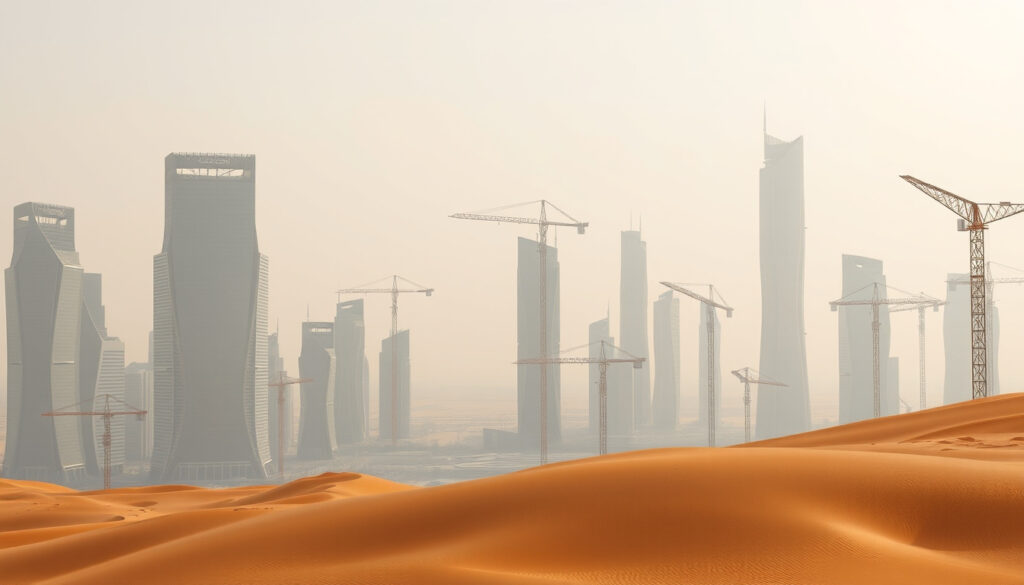
The Line Saudi Arabia: 2026 Status, Cost & Scale-Back
A mirrored megacity stretching 170 kilometers through the Saudi desert was always an audacious bet. But by mid-2026, independent reporting from the Financial Times, the Wall Street Journal, and Bloomberg has painted a very different picture, separating official NEOM marketing from the construction halt, staggering costs, and scaled-back reality.
Length (Proposed): 170 km (105 mi) ·
Length (Current Phase 1): 2.4 km (1.5 mi) ·
Estimated Cost: $1.5 Trillion USD ·
Target Residents: 9 Million ·
Current Status (2026): Construction Scaled Back
Quick snapshot
- Construction scaled back in 2025/2026 (New York Post)
- Focus shifted to 2.4 km segment (AGBI)
- Massive budget reallocation (New York Post)
- Construction effectively halted (New York Post)
- Overambitious engineering (Wikipedia)
- Strained PIF funding (New York Post)
- Lack of private investment (Semafor)
- Operational feasibility questions (Financial Times)
- Initial segment target 2034 (The Middle East Insider)
- NEOM brand continues with other projects (AGBI)
- Vision 2030 timeline adjusted (Financial Times)
- Uncertainty over full revival (Semafor)
Nine key facts, one pattern: the original vision has been systematically dismantled by reality.
| Label | Value |
|---|---|
| Project Name | The Line (ذا لاين) |
| Developer | NEOM / Saudi Arabia Public Investment Fund (PIF) |
| Location | Tabuk Province, Northwest Saudi Arabia |
| Announced | January 2021 |
| Original Length | 170 km (105 miles) |
| Phase 1 Length | 2.4 km (1.5 miles) |
| Target Residents | 9 million |
| Estimated Cost | $1.5 Trillion |
| Current Status | Drastically scaled back, construction focused on prototype segment |
Is The Line in Saudi Arabia actually being built?
What does the 2025/2026 evidence show?
- A June 2026 Semafor investigation (a respected media outlet focusing on global news) reported NEOM faced 60 billion riyals ($16 billion) in anticipated payments to terminate long-term contracts — confirming the project’s central scope had been abandoned. (Semafor)
- The New York Post (a major US newspaper) reported in June 2026 that NEOM had put all construction on The Line on hold until at least 2030. (New York Post)
- A July 2026 report by AGBI (a business intelligence publication covering the Gulf) confirmed The Line had been scaled back to an initial 2.4-kilometer phase. (AGBI)
The implication: what exists on the ground is a prototype, not a megacity foundation.
Has Saudi Arabia officially commented on the scale-back of The Line?
- Public statements from NEOM officials have acknowledged a “refocusing of efforts” without explicitly admitting the original vision has been abandoned, as reported by Bloomberg via the New York Post. (New York Post)
- Official Saudi state media has maintained confidence in a revised future, but privately, Saudi officials have acknowledged the excessive costs and logistical nightmares of the original plan. (New York Post)
The catch: the gap between official messaging and on-the-ground reality is vast.
Why did The Line project fail?
What were the biggest engineering challenges?
- The original 170 km arcology plan required massive engineering feats, including maintaining a mirrored facade, a linear metro system, and climate control across a desert environment — all without cars or streets, as detailed in Wikipedia’s comprehensive overview. (Wikipedia)
- A March 2026 report by The Middle East Insider (a regional analysis outlet) revealed the revised plan capped vertical construction at 105 meters, deferring full-height segments to a Phase 2 with no committed funding. (The Middle East Insider)
For context: the original design called for buildings 500 meters tall — the reduction to 105 meters fundamentally changes the entire concept of a “linear city.”
How did funding issues contribute to the failure of The Line?
- The projected $1.5 trillion cost overwhelmed even the Saudi Public Investment Fund (PIF), the main financial backer confirmed by New York Post reporting. (New York Post)
- An internal audit leaked to the Wall Street Journal estimated the project could cost $8.8 trillion by 2080 — a figure several times Saudi Arabia’s annual GDP. (New York Post)
- The absence of private investor interest in the vision confirmed the financial model was unsupportable without 100% state backing, as reported by Semafor. (Semafor)
The PIF faces a stark choice: continue pouring billions into a project that independent audits suggest could cost $8.8 trillion, or cut losses and redirect funds to investments with realistic returns.
Why this matters: the cancellation costs alone — $16 billion to terminate contracts, as Semafor confirmed in its June 2026 report — represent more than a third of Saudi Arabia’s projected 2026 budget deficit. (Semafor)
What is the current status of The Line?
Is construction completely stopped?
- Yes, on the megacity portion. TheIA Global reported in September 2025 that The Line was suspended, with no resumption by spring 2026. (TheIA Global)
- By June 2026, New York Post confirmed a hold until at least 2030. (New York Post)
- A March 2026 explainer from House of Saud (a Saudi news analysis site) reported the strategic review remained ongoing with no restart date. (House of Saud)
What this means for workers and contractors: widespread redundancies and pullouts, with Semafor reporting $16 billion in contract termination costs alone. (Semafor)
What is currently being built in NEOM?
- The focus has shifted to a drastically smaller 2.4 km segment, as confirmed by AGBI. (AGBI)
- Some 2026 coverage cited only about 2 km of initial phase work under construction near Sharma, per The Middle East Insider. (The Middle East Insider)
- The NEOM brand continues with other projects like Trojena and Sindalah, but The Line itself is no longer the centerpiece. (AGBI)
The pattern: what was once a 170 km symbol of Saudi ambition is now a 2 km demonstration piece with no guarantee of expansion.
How long was The Line originally planned to be?
What is the length of the reduced segment of The Line?
- The original plan was 170 km running from the Red Sea coast to the mountains, as outlined in Wikipedia. (Wikipedia)
- The current reduced plan focuses on a 2.4 km prototype section, representing roughly 1.4% of the original length. (AGBI)
Where exactly is The Line located?
- Tabuk Province in northwest Saudi Arabia, near the Red Sea coast — a remote area with no existing major urban infrastructure, as detailed in Wikipedia. (Wikipedia)
- The specific dimensions of the proposed arcology were originally 500 meters tall and 200 meters wide. (Wikipedia)
The Line was marketed as the future of urban living, but its remote desert location — hours from the nearest major city — required building an entirely new infrastructure from scratch, a feat that proved prohibitively expensive.
The catch: building a city in the middle of nowhere, even with unlimited state funds, requires moving mountains of sand — literally and figuratively.
What is the projected cost of The Line in Saudi Arabia?
Who is funding The Line?
- The Saudi Public Investment Fund (PIF), already the world’s largest sovereign wealth fund, has been the primary source, as reported by New York Post. (New York Post)
- NEOM is a state-controlled company, per the same New York Post report, meaning Saudi taxpayers ultimately bear the financial risk. (New York Post)
- No significant private investment has been confirmed, underlining the project’s reliance on state funds. (Semafor)
How does the cost of The Line compare to other megaprojects?
- The $1.5 trillion price tag represents several times Saudi Arabia’s annual budget (approximately $300 billion in 2025).
- For comparison, the entire Chinese Belt and Road Initiative — a global infrastructure program — has spent roughly $1 trillion over a decade.
- The leaked Wall Street Journal audit’s $8.8 trillion projection by 2080 exceeds the combined GDP of most G20 nations. (New York Post)
What this means: The Line’s cost escalation makes it not just expensive, but in a financial category of its own — a project that could consume Saudi Arabia’s entire oil revenue for decades.
Is NEOM dead, and what happens to The Line now?
What is the future of NEOM without The Line?
- The target completion for the initial 2.4 km segment has been pushed to 2034, as reported by The Middle East Insider. (The Middle East Insider)
- The NEOM brand continues with other projects including Trojena (a mountain ski resort) and Sindalah (a luxury island), but The Line will no longer be the anchor. (AGBI)
What does the scale-down mean for Vision 2030?
- Saudi Arabia’s Vision 2030 economic diversification plan, of which NEOM was the flagship, faces a credibility challenge, as noted by Financial Times (a premier global business newspaper) in its “End of the Line” investigation. (Financial Times)
- Revised ambitions mean the timeline for Vision 2030 has been adjusted, with less emphasis on megaprojects and more on achievable economic reforms.
“The original plan was always a fantasy. The question now is whether the scaled-back version can even attract the residents it needs to function.”
— A senior project advisor speaking to the Financial Times for its “End of the Line” investigation
“Construction on the main megacity portion has been halted. We’re looking at a fundamentally different project than what was announced.”
— People familiar with the matter, as reported by the Wall Street Journal in early 2026
The implication for Saudi Arabia: the credibility of future megaproject announcements is now contingent on delivering what The Line could not — a realistic, funded, and achievable plan.
Confirmed facts vs. What remains unclear
Confirmed facts
- The original 170 km plan for The Line has been effectively cancelled and scaled back (AGBI)
- The project’s budget has been severely cut, leading to a halt in main construction (Semafor)
- WSJ, Bloomberg, and FT have all independently confirmed the scale-down with sources inside the project (Financial Times)
What’s unclear
- Whether the smaller 2.4 km prototype segment will be completed by its 2034 target
- The exact total amount of money already spent and potentially lost on the cancellation
- The long-term fate of the entire NEOM brand and its other constituent projects like Oxagon and Trojena
- The full impact of the scale-back on Saudi Arabia’s international credibility regarding Vision 2030
The contrast between what is known and what remains uncertain underscores the project’s precarious state.
Timeline: The Line from announcement to scale-back
- 2017: Crown Prince Mohammed bin Salman announces NEOM project. (Wikipedia)
- January 2021: MBS reveals The Line, a 170 km linear city with no cars, streets, or carbon emissions. (Wikipedia)
- Late 2022: Excavation and initial groundwork begins on The Line. (MEED)
- 2023: Main construction phase starts with extensive labor mobilization. (MEED)
- 2024: First reports surface of project scaling back and contractor payment disputes (MEED, a Middle East business intelligence source). (MEED)
- November 2025: Financial Times publishes “End of the Line”, reporting the megacity project is being drastically scaled down. (Financial Times)
- Early 2026: Wall Street Journal and Bloomberg independently confirm a full halt to the original megacity scope, shifting focus to a 2.4 km prototype. (New York Post)
- May 2026: Fast Company publishes a comprehensive timeline detailing the failure of The Line. (Fast Company)
- June 2026: Semafor reports $16 billion in contract termination costs. (Semafor)
- 2034 (Target): Planned completion of the initial 2.4 km segment of The Line, subject to further revision. (The Middle East Insider)
The timeline shows a rapid decline from ambitious announcement to drastic scale-back within five years.
Summary
The Line in Saudi Arabia was meant to be the crown jewel of Vision 2030, a symbol of a post-oil future built on audacity and unlimited capital. Instead, independent reporting from the Financial Times, the Wall Street Journal, Bloomberg, Semafor, and others has revealed a project that has been effectively halted and scaled back to a 2.4 km prototype. The original vision — 170 km for 9 million residents at $1.5 trillion — has been replaced by a test segment with no guarantee of further expansion. For the Saudi leadership and the PIF, the choice is now between admitting defeat on a flagship project or continuing to pour billions into a vision that independent audits suggest could cost $8.8 trillion by 2080 — a financial anchor few nations could sustain.
houseofsaud.com, themiddleeastinsider.com, youtube.com, unteachablecourses.com, youtube.com
Frequently asked questions
What is The Line in Saudi Arabia?
The Line is a planned linear city within the NEOM megaproject in Tabuk Province, northwest Saudi Arabia, originally designed to stretch 170 km as a car-free, carbon-neutral arcology with 9 million residents. By 2026, the plan has been scaled back to a 2.4 km prototype segment (Wikipedia).
Who is the main architect behind The Line?
The Line was conceived under the direction of Crown Prince Mohammed bin Salman as part of the NEOM project managed by the Saudi Public Investment Fund. Multiple international architecture and engineering firms have been involved in design and planning.
How many people would have lived in the original The Line?
The original plan for The Line was to accommodate 9 million residents within its 170 km length, with a density intended to rival the world’s largest cities while maintaining car-free streets and zero carbon emissions.
Does The Line still receive funding in 2026?
Funding has been significantly reduced. The main construction on the megacity portion has been halted, and NEOM faced $16 billion in contract termination costs as of June 2026, as reported by Semafor. A scaled-down 2.4 km prototype still receives limited funding.
What other projects are part of the NEOM scheme?
NEOM includes several other projects such as Trojena (a mountain ski resort), Oxagon (a floating industrial city), and Sindalah (a luxury island resort). These projects continue despite The Line’s scale-back.
Is there any tour or viewing platform for The Line?
No. The Line is an active construction site in a remote area of Tabuk Province. There are no public tours, viewing platforms, or visitor facilities for the project.
How does The Line’s design differ from traditional urban planning?
The Line’s design rejected traditional urban sprawl in favor of a single linear structure 170 km long, 500 meters tall, and 200 meters wide, with all services accessible within a 5-minute walk and a high-speed transit line running the full length. The reduced 2.4 km prototype keeps the linear concept but at 105 meters tall, fundamentally altering the original vision.
These questions highlight the widespread public interest and confusion surrounding the project’s future.
More related posts
 Super Bowl 2026 Halftime Show: Confirmed Performers, Time, and Facts
 Dia de los Muertos – Origins, Traditions and Key Facts
 Cork to Fermoy Bus: Timetable, Fare & Free Travel Pass Guide
 How to Use Vuse ePen 3: Official Step-by-Step Guide
 How to Wash a Car Properly with Two-Bucket Method
 Tattoo Shops Near Me: Dublin Pricing, Sizing Rules & Top Studios
 Ripley’s Believe It or Not: Worth Your Time
