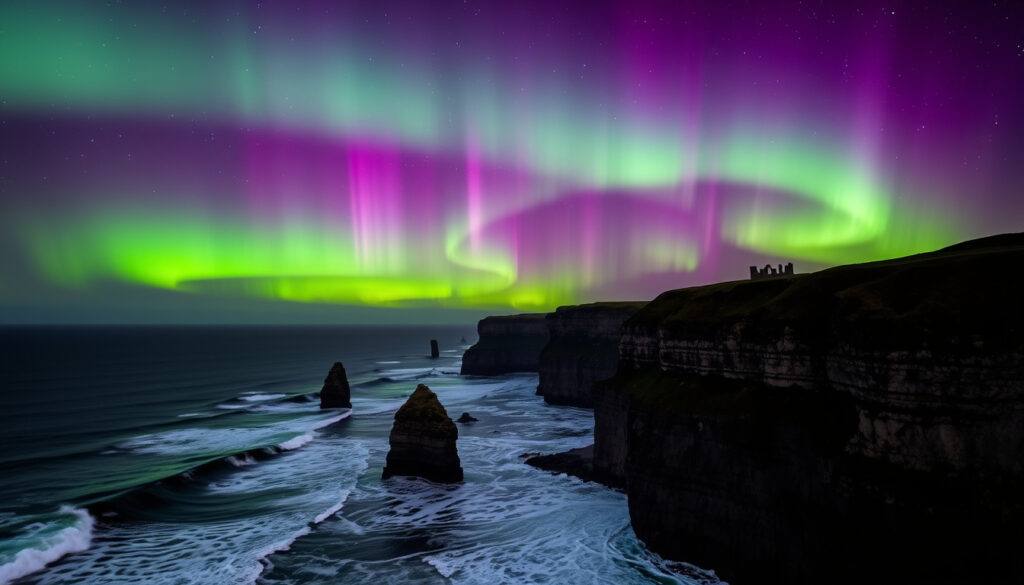
What Are the Northern Lights? Causes, Myths & Ireland Sightings
There’s something almost otherworldly about watching ribbons of green light ripple across the night sky. Recent solar activity has pushed aurora visibility far south of its usual haunts, and Ireland is getting front-row seats to the show.
Scientific Name: Aurora Borealis · Primary Cause: Charged particles from Sun colliding with atmosphere · Common Colors: Green, purple, red · Visibility Region: Northern hemisphere high latitudes · Forecast Tool: Northern lights Ireland forecast
Quick snapshot
- Solar particles travel 150 million km to Earth (Hurtigruten)
- Green light forms at 100–200 km altitude from oxygen (Natural History Museum UK)
- Specific body effects remain loosely documented
- Whistling taboos trace to pre-scientific folk wisdom with no empirical basis
- Scientists didn’t explain auroras until the 1950s space race era (RTE Brainstorm)
- Solar activity cycles suggest enhanced visibility through 2026 (RTE Brainstorm)
- Lower-latitude sightings may continue as solar maximum approaches
- Irish skywatchers can monitor Met Éireann aurora forecasts
The table below summarizes key attributes of the aurora borealis phenomenon.
| Attribute | Value |
|---|---|
| Alternative Name | Aurora Borealis |
| Formation Height | Earth’s upper atmosphere |
| Trigger | Charged particles from Sun |
| Primary Color | Green from oxygen |
| Forecast Tool | Northern lights Ireland forecast |
What actually causes the northern lights?
The Northern Lights emerge when charged particles ejected from the Sun barrel through space and slam into Earth’s upper atmosphere. According to Met Éireann (Ireland’s official meteorological service), these collisions with gas particles in our atmosphere are what produce the glowing display we call aurora borealis. Those particles have traveled roughly 150 million kilometers to get here — a journey that takes anywhere from two to several days depending on solar wind speed, according to Hurtigruten’s aurora science guide.
Interaction with Earth’s magnetic field
Earth’s magnetic field doesn’t just sit there passively. It acts like a massive funnel, scooping solar particles toward the planet’s north and south magnetic poles. The Natural History Museum UK explains that this magnetic interaction is what concentrates aurora activity in ring-shaped zones around the poles rather than spreading it evenly across the globe. When solar activity spikes and sunspots release coronal mass ejections, more particles flood the system — and the lights intensify and expand equatorward.
Role of solar activity
The Sun follows an approximately 11-year cycle of waxing and waning activity. During peaks, sunspots churn out coronal mass ejections — vast clouds of charged plasma hurtling outward at thousands of kilometers per second. RTE Brainstorm reports that these high-activity periods directly boost aurora frequency and intensity. Around the equinoxes, the geometry works even more in viewers’ favor: Earth’s magnetic field and the solar wind align in ways that let more particles penetrate the atmosphere, creating enhanced displays in late March and September.
The implication: you’re not imagining it when the lights seem more active in spring and fall — the physics actually favors those windows.
Why is Ireland seeing the northern lights?
Ireland sits well south of the Arctic Circle, nowhere near the auroral oval where Northern Lights typically concentrate. Yet RTE Brainstorm reports that the Northern Lights are sometimes visible in skies over Ireland when ideal geomagnetic and weather conditions line up. The recent surge in Irish sightings traces directly to heightened solar activity pushing the auroral oval farther south than usual — and Irish skywatchers have been rewarded with displays that even longtime residents describe as unprecedented.
Recent solar activity boosts
Strong coronal mass ejections have bombarded Earth’s magnetosphere with far more particles than typical quiet-Sun conditions. RTE Brainstorm explains that these ejections travel at thousands of kilometers per second, arriving at Earth days after leaving the Sun. When the incoming stream is dense enough, even mid-latitude observers — including those in Ireland — get a chance to catch the show. Solar cycle 25 is trending stronger than many predictions, suggesting this elevated activity could persist through the cycle’s expected peak around 2026.
Visibility in lower latitudes
The aurora borealis can appear much farther from the poles than most people assume. Culturally Ours notes that northern lights have been spotted as far south as New Orleans in the western hemisphere. When geomagnetic storms are strong enough, the oval expands dramatically — bringing the lights within range of countries like Ireland, northern England, and even parts of Germany and France during major events.
What this means: you don’t need to fly to Norway or Iceland for a chance. Timing and solar conditions matter more than latitude during strong storms.
Irish historic records of aurora borealis survive in folklore, newspapers, and scientific reports — yet prior to electric lighting, people had much more exposure to astronomical phenomena with no light pollution obscuring the night sky, according to RTE Brainstorm. Modern observers have advantages in forecasting and photography, but the skies themselves were darker for centuries of aurora witnesses.
Are the northern lights safe?
From a health standpoint, the Northern Lights pose no danger to observers on the ground. The aurora forms at altitudes between roughly 100 and 320 kilometers — far above any aircraft cruising altitude and well clear of where humans physically stand. The charged particles that create the glow interact with atmospheric gases at those heights, never reaching the surface.
Health effects on body
The Northern Lights themselves are entirely harmless to human health. The NASA Science Auroras page confirms that the phenomenon is purely an atmospheric light show — no radiation, no particles, no energetic waves reach people watching from below. You can safely watch a display for hours without any physiological impact.
Good or bad impacts
Beyond the visual spectacle, auroras have inspired cultural meaning for millennia — which can be psychologically powerful even if not medically quantifiable. RTE Brainstorm notes that historic Irish communities interpreted the lights as signs of coming rain, frost, or storms — a folk meteorological tradition that shaped agricultural expectations. The lights carry no actual predictive power over weather, but their psychological resonance in communities was very real.
The catch: while the lights themselves are harmless, chasing them means driving to dark locations in remote areas at night — which carries standard outdoor nighttime safety considerations.
What is so special about the northern lights?
The Northern Lights combine physics and theater in a way few natural phenomena match. They appear without warning, shift shape moment to moment, and paint the sky in colors that no photograph fully captures. The Natural History Museum UK notes that the lights can reach heights of up to 620 miles — roughly the distance from Dublin to Rome — making them the largest natural light show on Earth.
Unique colors and rarity
Green dominates because oxygen is most abundant at the 100–200 kilometer altitudes where auroras form, and human eyes are most sensitive to green light. The Natural History Museum UK explains that red auroras, produced by high-altitude oxygen more than 200 kilometers up, are rarely seen — not because they’re intrinsically rare but because oxygen becomes sparse at those heights. Blue and purple auroras indicate the presence of nitrogen molecules, according to Met Éireann.
Aurora borealis means “dawn of the north” while Aurora australis means “dawn of the south” — naming that captures the ethereal quality humans have projected onto these displays for millennia.
— Culturally Ours cultural heritage publication For those looking to experience this magic firsthand, you can find more information about cheap flights to Orlando.
Frequency of occurrence
At high-latitude hotspots like Alaska, northern Norway, and Iceland, active displays occur roughly 100–200 nights per year. Natural Habitat Adventures wildlife travel specialist notes that the phenomenon is most commonly witnessed during fall and winter at high-latitude locales, when longer nights mean more darkness and typically clearer skies. For mid-latitude observers like those in Ireland, the windows are narrower and tied to specific solar events.
The trade-off: the farther north you travel, the more frequently you’ll see displays — but big solar storms can bring the lights almost to your doorstep if you’re willing to watch the forecast.
Myths and legends about the Northern Lights
Before modern science explained auroras, humans did what we always do: told stories. The Northern Lights spawned a rich tapestry of folklore across cultures — some benign, some ominous, some frankly bizarre. RTE Brainstorm notes that Irish tradition called the aurora “streamers” into the twentieth century, a term that suggests how observers interpreted those wavering curtains of light. The aurora confounded scientific explanation until the 1950s space race finally gave researchers tools to trace it back to the Sun.
Irish folklore
Irish communities had their own aurora mythology. RTE Brainstorm documents that Irish people historically interpreted the lights as a sign of coming rain, frost, or storms — folk weather wisdom with no meteorological foundation. A 1930s schools folklore collection captured reports that people believed matter fell from the sky after Northern Lights sightings, and that this material was said to be a cure for burns. Whether any substance was actually collected or this was pure folk belief isn’t clear in the historical record.
Cultural taboos and Bible references
Many cultures developed taboos around aurora behavior. Folklore Thursday ethnography resource documents that in Scandinavian folklore, folk often feared a vengeful Aurora that would maim or kill those who mocked it. The Danes believed the lights were caused by swans competing to see who could fly furthest north — with some swans becoming trapped in ice, flapping their wings to create flurries of light. Natural Habitat Adventures notes that the Inuit at Point Barrow, Alaska’s northernmost spot, believed the aurora was evil and carried knives to protect themselves from it.
Cultures that feared auroras the most — carrying knives, avoiding eye contact, staying indoors — were usually those closest to where displays occurred most frequently. Meanwhile, visitors from lower latitudes who saw auroras rarely viewed them with dread.
Confirmed facts vs. rumors
Confirmed facts
- Charged particles from the Sun collide with atmospheric gases to produce auroras (Met Éireann)
- Green auroras dominate because oxygen is most abundant at 100–200 km altitude (Natural History Museum UK)
- The Northern Lights are sometimes visible in skies over Ireland during strong geomagnetic storms (RTE Brainstorm)
- The aurora continued to confound scientific explanation until the 1950s space race era (RTE Brainstorm)
- Northern and southern auroras are mirror-like images occurring simultaneously with similar shapes and colors (Culturally Ours)
Rumors and unverified claims
- The whistling taboo: folklore warns that whistling at the Northern Lights summons bad luck — this traces to pre-scientific folk belief with no empirical testing
- The fallen matter cure: 1930s Irish folklore claimed substances fell from the sky after aurora sightings and cured burns — no physical evidence documented
- Specific body effects: some sources claim auroras can affect human health or sleep, but no peer-reviewed mechanism has been established for ground-level viewers
“Auroras are vibrant light displays created when energetic particles from the Sun interact with Earth’s magnetic field and atmosphere.”
Related reading: Big Bang Theory · Iceland
Recent auroras visible in Ireland align with moderate geomagnetic activity tracked in the northern lights forecast tonight, including Kp index maps for prime viewing spots.
Frequently asked questions
What are the southern lights?
The southern lights are called Aurora Australis — essentially the mirror image of the Northern Lights occurring around the south magnetic pole. According to Culturally Ours, northern and southern auroras occur simultaneously and display similar shapes and colors.
How often are the northern lights?
At prime viewing locations like Alaska, Norway, or Iceland, active displays occur roughly 100–200 nights per year. For mid-latitude locations like Ireland, opportunities are far rarer and depend entirely on major solar events — typically just a handful of nights per decade.
What are the northern lights tonight?
Tonight’s visibility depends on current solar activity levels and geomagnetic storm intensity. Irish observers can check Met Éireann’s aurora resources or dedicated space weather forecasting services for real-time probability assessments.
Why does 2026 look bright for northern light sightings?
The Sun operates on an approximately 11-year activity cycle, and Solar Cycle 25 is trending stronger than predicted. The cycle’s maximum — when sunspot activity and coronal mass ejections peak — is expected around 2026, meaning more frequent and intense aurora displays globally, including at lower latitudes.
What is the rarest color of the northern lights?
Red aurora is the rarest color, appearing only when oxygen molecules at 200+ kilometers altitude are excited. According to The Natural History Museum UK, the thin atmosphere at those heights means less oxygen is available to produce the red glow.
Are northern lights good or bad?
The Northern Lights are neither inherently good nor bad — they’re a neutral natural phenomenon. Historically, some cultures considered them ominous or prophetic, while others saw them as spiritual or beautiful. Today, they’re primarily valued as a spectacular natural display and a tourism draw for northern regions.
Northern lights Ireland forecast?
Met Éireann provides educational resources about auroras, and dedicated aurora forecast services track real-time geomagnetic conditions. For Irish skywatchers, the best strategy is to monitor space weather indices during periods of elevated solar activity.
More related posts
 Villeroy and Boch Ireland: Stockists, Outlet & Online Guide
 Scottish Mortgage Share Price: Live SMT.L Quote & Analysis
 Top Corporate Law Firms in Guernsey: Legal500 & Bar List
 Wordle The New York Times: Play, Hints, App Guide
 Galaxy A50s to Buy: Ireland Deals, Reviews & Value
 How to Return a SHEIN Order: Step-by-Step Guide
 What Are RevPoints? A Complete Guide to Revolut’s Loyalty Programme
 Sharlene Mawdsley & Michael Breen: Relationship, Career, Timeline
