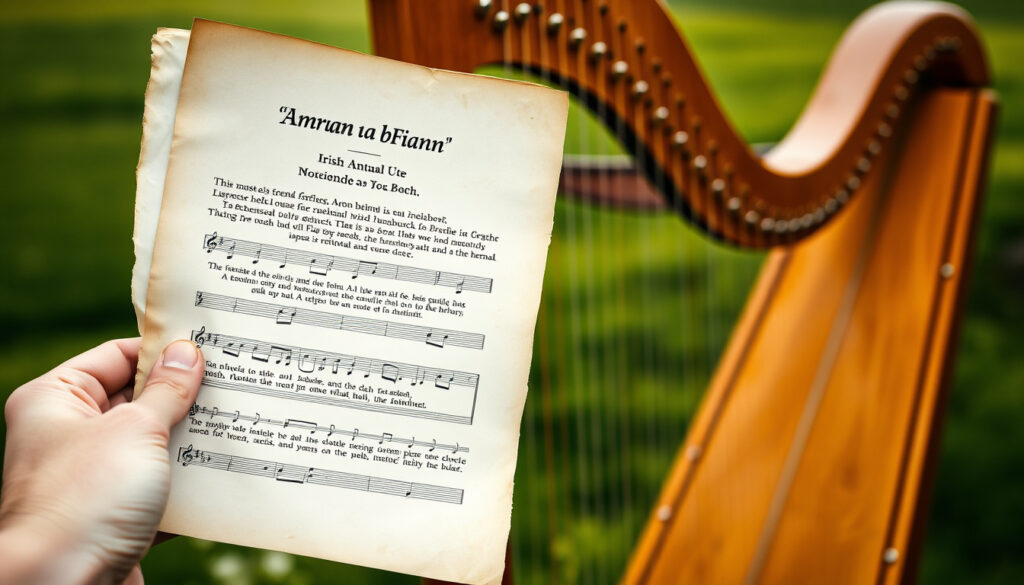
Amhrán na bhFiann Lyrics: Irish Text, Translation & Pronunciation
Few national songs carry the weight of history like Ireland’s anthem, Amhrán na bhFiann. Whether you’ve stood for it at a rugby match or are just now trying to pronounce its title, the lyrics tell a story of independence and identity. Written in 1907 by Peadar Kearney and adopted officially in 1926, this guide covers the full Irish text, the English translation, how to pronounce it, and the debates surrounding its future.
Year written: 1907 ·
Official adoption year: 1926 ·
Number of verses: 3 (first commonly sung) ·
Language: Irish (Gaeilge) ·
Lyricist: Peadar Kearney ·
Composer: Patrick Heeney
Quick snapshot
- Official Irish lyrics published by the Irish government (Department of the Taoiseach)
- Adopted as national anthem on 12 July 1926 per IrishCentral
- Lyrics by Peadar Kearney, music by Patrick Heeney (The Irish Post)
- Exact English translation nuances vary between sources (gov.ie provides the official version)
- Whether a new, more inclusive anthem will be officially considered in future (The Irish Post)
- 1907/1909 – Lyrics written (gov.ie)
- 1912 – First published in Irish Freedom (History Ireland)
- 1926 – Officially adopted (IrishCentral)
- 2021 – Political calls for a new anthem (The Irish Post)
- No formal proposal for a new anthem has been approved (The Irish Post)
- Current official text remains the only recognized version for state occasions (gov.ie)
Six facts define the anthem’s official profile, from its language to its copyright history.
| Label | Value |
|---|---|
| Official language | Irish (Gaeilge) |
| Adopted | 1926 |
| Lyricist | Peadar Kearney |
| Composer | Patrick Heeney |
| Number of verses | 3 (first verse commonly sung) |
| English title | The Soldier’s Song |
What are the lyrics of Amhrán na bhFiann in Irish?
Full Irish lyrics (first verse)
The Irish government publishes the exact words for state use.
According to the Irish government’s official page (Department of the Taoiseach), the first verse reads:
Sinne Fianna Fáil,
Atá faoi gheall ag Éirinn,
Buíon dár slua
Thar toinn do ráinig chugainn,
Faoi mhóid bheith saor,
Seantír ár sinsear feasta,
Ní fhágfar faoin tíorán ná faoin tráill.
Anocht a théam sa bhearna bhaoil,
Le gean ar Ghaeil chun báis nó saoil,
Le gunna scréach faoi lámhach na bpiléar,
Seo libh canaigí Amhrán na bhFiann.
Full Irish lyrics (all three verses)
Only one verse is widely performed, but the complete text has three.
The complete anthem consists of three verses, though only the first verse and chorus are commonly sung at official events. The government’s official publication (gov.ie) includes the full Irish text of all three verses as well as the English version.
Official Irish text from government source
- gov.ie: definitive source for state-recognized lyrics
For the definitive version, the Irish government provides the official lyrics in both Irish and English on gov.ie (Department of the Taoiseach). This is the only source that carries the state’s authority for the anthem’s text.
The implication: The official Irish text is fixed by the state, but only a fraction of it is performed publicly—the rest remains a historical document.
What are the lyrics of Amhrán na bhFiann in English?
English translation of the first verse
The official English rendering is a marching poem, not a literal translation.
The English version, commonly known as “The Soldier’s Song” (gov.ie), translates the Irish:
Soldiers are we,
whose lives are pledged to Ireland;
Some have come
from a land beyond the wave;
Sworn to be free,
No more our ancient sireland,
Shall shelter the despot or the slave.
Tonight we man the gap of danger
In Erin’s cause, come woe or weal,
’Mid cannons’ roar and rifles’ peal,
We’ll chant a soldier’s song.
Literal vs. poetic translation
- Poetic: “Soldiers are we” — Literal: “We are the warriors of Fál” (according to SongsInIrish.com)
- Poetic: “lives are pledged to Ireland” — Literal: “who are under a vow to Ireland”
The official English version sacrifices literal accuracy for rhythm and rhyme—standard practice for national anthems worldwide.
Meaning of key phrases
- “Fianna Fáil” — an ancient term meaning “Warriors of Destiny” or “Soldiers of Ireland” (SongsInIrish.com)
- “Faoi gheall ag Éirinn” — “pledged to Ireland”
- “Bearna bhaoil” (gap of danger) — a mythological breach in battle lines that heroes must defend (The Irish Post)
The catch: The two translations are effectively different songs—one is a battle cry in Irish, the other an Edwardian marching tune in English—which reflects the anthem’s dual identity.
A visitor relying only on the English version would miss the more militant, direct tone of the original Irish—a difference that fuels some calls for a new anthem.
How do you pronounce Amhrán na bhFiann?
Phonetic pronunciation guide
- “Amhrán” — /ˈəʊrɑːn/ (OW-rawn, stress on first syllable)
- “na” — /nə/ (nuh)
- “bhFiann” — /viːən/ (vee-un, the “bh” makes a V sound)
Full pronunciation: “ow-rawn na vee-un” (guides from Gaelscoil Online and Bitesize Irish provide more detail).
Audio resources for correct pronunciation
- Gaelscoil Online – line-by-line breakdown with audio
- Bitesize Irish – video pronunciation guide
- gov.ie – official state recording
Common pronunciation mistakes
- Pronouncing “bhFiann” as “bee-an” instead of “vee-un” — the “bh” is a V sound, not B
- Stressing the second syllable of “Amhrán” (correct: stress on first)
- Dropping the slender final “n” in “bhFiann” — it carries a slight palatal quality (Gaelscoil Online)
The trade-off: Getting the pronunciation right matters for respect, but even native Irish speakers vary in how they say the anthem’s title depending on dialect.
For a detailed breakdown, see our Pronunciation guide for Amhrán na bhFiann.
Where can I get a PDF of Amhrán na bhFiann lyrics?
Download from government website
The gov.ie PDF is the only text with state authority.
The Irish government provides a printable PDF of the anthem on gov.ie (Department of the Taoiseach). The PDF includes the Irish and English lyrics and the official music score.
Printable PDF from educational sites
- SongsInIrish.com – free PDF with Irish lyrics, translation, and chords
- Various Irish language forums offer classroom-ready versions
Educational sites like these are useful for school projects or choral practice.
Using PDF for classrooms or events
- Public performance is generally permitted without licensing
- Copyright was purchased by the Irish Free State in 1933 (per Stair na hÉireann historical post)
- Non-commercial educational use is allowed
The implication: The official PDF is the authoritative version; third-party sites add chords and translations but may contain errors.
Is there a new Irish national anthem?
Background on calls for a new anthem
- Some politicians argue the current anthem is too militaristic for modern Ireland
- The anthem’s focus on nationalist struggle does not represent a pluralist society
- Reports describe the anthem’s history as “troubled” (The Irish Post)
Official status: no change
No proposal to replace the anthem has been approved by the government.
Despite the discussions, no official proposal to replace the anthem has been approved by the Irish government. The current anthem remains the only national anthem of Ireland, as confirmed by gov.ie.
Proposed alternatives
- Suggestions include non-militaristic lyrics that include Northern Irish voices
- No alternative has gained broad political support (The Irish Post)
Why this matters: The debate highlights a tension between honoring tradition and adapting to modern values—a conversation that is far from resolved.
Timeline of Amhrán na bhFiann
- 1907/1909 – Lyrics written by Peadar Kearney, music by Patrick Heeney (gov.ie)
- 1912 – First published in Irish Freedom magazine (History Ireland)
- 1916 – Sung by rebels during the Easter Rising (The Irish Post)
- 1926 – Officially adopted by the Irish Free State on 12 July (IrishCentral)
- 1933 – Copyright purchased by the state (Stair na hÉireann)
- 2021 – Calls for a new, more inclusive anthem; no change enacted (The Irish Post)
Clarity check: What’s confirmed and what’s unclear
Confirmed facts
- Official Irish lyrics published on gov.ie
- Adopted in 1926 (IrishCentral)
- Lyrics by Peadar Kearney, music by Patrick Heeney (The Irish Post)
- First verse is most commonly performed (gov.ie)
What’s unclear
- Exact year of composition is uncertain (gov.ie says 1907 or 1909; The Irish Post says 1910)
- Exact translation nuances vary (SongsInIrish.com notes variation)
- Whether a new anthem will be officially considered in the future (The Irish Post)
- Full extent of alternative translations beyond the official version remains unclear
Voices on the anthem
The national anthem of Ireland is ‘Amhrán na bhFiann’ / ‘The Soldier’s Song’.
— Irish government (Department of the Taoiseach)
The Executive Council of the Irish Free State officially adopted ‘Amhrán na bhFiann’ on 12 July 1926.
— IrishCentral reporting on adoption
The song has a troubled history behind it, reflecting the contested memory of its origins and adoption.
— The Irish Post
For anyone learning Amhrán na bhFiann, the journey goes beyond memorizing words. The anthem encapsulates a century of Irish identity—from its rebel origins to its current place at international events. As debates continue over its future, the lyrics remain a living piece of history. For learners, the choice is clear: master the Irish pronunciation and meaning, or the anthem’s original voice remains out of reach.
walkingholidayireland.com, irishpost.com, en.wikipedia.org, youtube.com
Frequently asked questions
Who wrote the music for Amhrán na bhFiann?
The music was composed by Patrick Heeney, a contemporary of lyricist Peadar Kearney (gov.ie).
What does ‘Sinne Fianna Fáil’ mean?
According to SongsInIrish.com, it means “We are the warriors of destiny” or “We are the soldiers of Ireland”.
Is Amhrán na bhFiann copyrighted?
The lyrics’ copyright was purchased by the Irish Free State in 1933 and is now owned by the state (Stair na hÉireann). Performance for non-commercial use is generally allowed.
Can I sing the anthem at a wedding?
Yes, there are no restrictions on performing the anthem at private events like weddings, as long as it’s done respectfully (gov.ie guidelines).
What is the correct tempo for the anthem?
The official arrangement is played at a march tempo, approximately 100-110 beats per minute (gov.ie includes the music score).
Why is the anthem sometimes played in a minor key?
While the official version is in a major key, some performances interpret it in a minor key to emphasize its solemn, martial mood (The Irish Post analysis).
How do you spell Amhrán na bhFiann correctly?
The official Irish spelling is “Amhrán na bhFiann”, with capital A, acute accent on the first ‘a’, and lowercase ‘n’ for ‘na’ (gov.ie).
More related posts
 Premier Inn Dublin Docklands: Guide to Location & Amenities
 Sydney Sweeney American Eagle: Controversy & Boycott Explained
 Gullfoss Iceland: Complete Guide to Golden Falls from Reykjavik
 Second Hand Wedding Dresses Ireland: Where to Buy & Sell
 Sage Business Cloud Accounting: Pricing and Features
 New Balance 9060 Ireland: Prices & Best Deals
 Top Corporate Law Firms in Guernsey: Legal500 & Bar List
 L’Oréal Casting Crème Gloss: How to Use & Shade Guide
