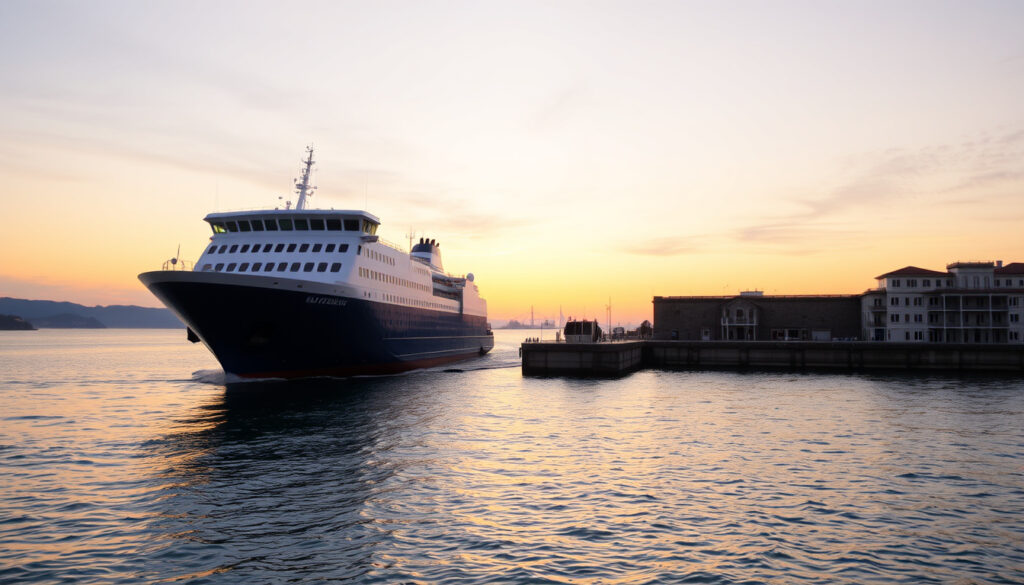
Rosslare to Fishguard Ferry: Timetable, Prices, and Tips (2025)
If you’re planning a trip between Ireland and Wales, the ferry from Rosslare to Fishguard is often the quickest link across the Irish Sea. Operated by Stena Line, the crossing takes roughly 3 hours 30 minutes and runs up to four times a day. Whether you’re taking a car or going as a foot passenger, this guide brings together the timetable, costs, and travel tips you need for a smooth crossing.
Crossing duration: 3 hours 30 minutes ·
Operator: Stena Line ·
Distance: 87 km (54 miles) ·
Frequency: Up to 4 crossings per day ·
Car & driver: From €179.50 single ·
Foot passenger price: Not specified – check operator or aggregator
Quick snapshot
- Stena Line operates the route (Stena Line official fares PDF)
- Crossing time ~3h 30m (Direct Ferries route guide)
- No passport needed for UK/Irish citizens (CTA) (UK Government border control guidance)
- Exact foot passenger price – not publicly listed on official site
- Sea conditions on a given day – depends on real-time weather forecasts
- Up to 4 daily sailings; check 48-hour updates (Stena Line FerryCheck)
- Schedules vary by season – summer more, winter less (Ferryhopper route summary)
- Book in advance – prices rise near departure (Stena Line official site)
- Arrive 60 min early for foot passengers (check official check-in rules) (Stena Line official site)
Here are the essential details at a glance:
| Item | Details |
|---|---|
| Port of departure | Rosslare Europort, County Wexford, Ireland |
| Port of arrival | Fishguard Harbour, Pembrokeshire, Wales |
| Operator | Stena Line |
| Duration | 3 hours 30 minutes (average) |
| Distance | 87 km (54 nautical miles) |
| Vessel | Stena Adventurer or Stena Superfast VIII (subject to schedule) |
| Check-in time | At least 30 minutes before departure for foot passengers; 45 minutes for vehicles |
| Travel documents | Valid passport for non-CTA travelers; photo ID for CTA citizens |
How long is the ferry from Rosslare to Fishguard?
The Rosslare to Fishguard crossing takes roughly 3 hours 30 minutes on the fastest scheduled sailings, according to the Stena Line official fare sheet and the Direct Ferries route guide. This makes it the shortest Ireland–Wales crossing, compared to the Rosslare–Pembroke route which typically takes over 4 hours.
What affects the crossing time?
- Weather and sea conditions – the Irish Sea can delay sailings by up to 30 minutes in winter storms or strong winds.
- Vessel type – Stena Line uses modern ferries like the Stena Adventurer with a cruising speed of about 22 knots (Stena Line fleet information).
Comparing with other routes
The Rosslare–Fishguard route is about 45 minutes shorter than the Rosslare–Pembroke crossing and is the only direct service from Rosslare to Wales. The next fastest option is the Dublin–Holyhead ferry, which takes around 3 hours 15 minutes but requires a different departure port. For alternative travel options within Ireland, you can check the Cork to Fermoy Bus: Timetable, Fare & Free Travel Pass Guide or the 101 Bus Timetable Drogheda to Dublin: Fares & Real-Time Info.
The implication: If you’re heading from southeast Ireland to south Wales, the Rosslare–Fishguard ferry is your most time-efficient choice – but always factor in a buffer for weather delays, especially between November and March.
Is the crossing from Fishguard to Rosslare rough?
The Irish Sea can be unpredictable, but the Rosslare–Fishguard crossing is generally calm thanks to the route’s protected position. Direct Ferries notes that most passengers describe the journey as comfortable, and modern ferries are equipped with stabilisers to reduce motion.
Typical sea conditions on the Irish Sea
- Summer months (May–September): calm to moderate, with occasional chop.
- Winter months (November–February): more frequent swells; check Met Éireann’s marine forecast or the UK Met Office shipping forecast before sailing.
Tips for passengers prone to seasickness
- Book a cabin or stay in the middle of the ship where motion is least felt.
- Choose a daytime crossing – the sea is generally calmer before noon.
- Over-the-counter remedies (e.g., Dramamine) are available at port shops.
What this means: For the vast majority of passengers, roughness is not a deal-breaker. If you’re worried, travelling in summer or taking the morning sailing dramatically reduces the chance of a bumpy ride.
How much is a foot passenger from Rosslare to Fishguard?
Exact foot passenger fares for the Rosslare–Fishguard route are not published on the official Stena Line website. However, third-party aggregators offer clues. Ferryhopper lists tickets starting at €44 for foot passengers, while Ferryscanner shows a range of €43 to €78. Car and driver fares start from €179.50 single according to the 2026 Stena Line fare sheet.
Foot passenger vs car driver pricing
- Foot passenger: €44–€100 one-way depending on demand and advance purchase.
- Car & driver: from €179.50 single; additional passengers pay their own foot fare.
- Cabin supplement: around €90 according to Ferryhopper.
Where to find the best deals
- Book on the Stena Line official site for direct fares and loyalty discounts.
- Compare across Direct Ferries, Ferryhopper, and Ferryscanner for real-time price comparisons.
- Choose off-peak days (Tuesday–Thursday) and sailings (midday or late evening) for lower rates.
The trade-off: Booking early saves money – but if you’re flexible, last-minute deals on aggregators can sometimes undercut published fares. For foot passengers, the lack of a public official fare makes it essential to check at least two aggregators before buying.
What are the sailing times from Rosslare to Fishguard?
Stena Line operates up to 4 sailings per day between Rosslare and Fishguard, according to Direct Ferries and Ferryhopper. The 2026 fare sheet from Stena Line lists departures from Rosslare at 08:15 and 19:30, and from Fishguard at 01:30 and 14:00 (Stena Line fares PDF).
Typical daily schedule
- Rosslare departures: 08:15, 12:00, 16:00, 19:30 (seasonal variation).
- Fishguard departures: 01:30, 06:00, 10:00, 14:00 (seasonal variation).
In summer, an extra afternoon sailing is often added; in winter, the route may drop to 2 crossings per day (Stena Line Travel port page).
How to check live updates
The Stena Line FerryCheck service provides real-time status for the next 48 hours, including delays and cancellations. Always check this before heading to the port, especially during autumn and winter.
Why this matters: The published timetable is a baseline – weather, maintenance, and seasonal changes can shift sailings. The smartest habit is to confirm the day before travel and again 2 hours before check-in.
Do you need a passport to go from Fishguard to Rosslare?
For British and Irish citizens, no passport is required for ferry travel between the UK and Ireland thanks to the Common Travel Area (CTA) agreement. The UK Government’s CTA guidance states that valid photo ID such as a driving licence is sufficient, though a passport is recommended as a backup.
Travel documents for UK and Irish citizens
- No passport required; photo ID (driving licence or passport card) strongly advised.
- Children under 18 travelling alone may need a letter of consent.
- Ferry staff may request identification at check-in or boarding.
Requirements for non-CTA travelers
- EU/EEA nationals: valid national identity card or passport.
- Other nationalities (US, Canada, Australia, etc.): valid passport. UK border control rules apply upon arrival in Fishguard.
- Visa requirements depend on nationality – check UK visa information before booking.
The pattern: For CTA residents, the crossing is almost as straightforward as domestic travel. But non-CTA nationals must treat it as an international border – have your passport ready and allow extra time for possible immigration checks.
Car drivers who book at least two weeks ahead can save up to 30% compared to last-minute fares – a pattern confirmed by Direct Ferries pricing data. Foot passengers face the opposite challenge: no published official fare means relying on aggregators, but the savings can be significant when demand is low.
While the route is advertised as having up to 4 daily sailings, the 2026 fare sheet shows only 2 scheduled departures in each direction – suggesting that the ‘up to 4’ claim is seasonal. Travellers in spring and autumn may find fewer options than expected.
Confirmed facts & what’s unclear
Confirmed facts
- Stena Line operates the Rosslare–Fishguard route (Stena Line official site).
- Crossing time is approximately 3 hours 30 minutes (Direct Ferries).
- Passport not required for UK and Irish citizens under the CTA (UK Government guidance).
- Check-in opens 2 hours before departure and closes 60 minutes before for foot passengers (Stena Line FerryCheck).
What’s unclear
- Exact foot passenger price – not publicly listed on official site.
- Degree of roughness on any given day – depends on real-time weather; check Met Éireann or UK Met Office.
- Exact number of daily sailings outside summer season – official and aggregator sources differ.
- Exact vessel assignment for each sailing is not guaranteed and may change on the day.
- The check-in time policy may vary between Stena Line and aggregator recommendations.
“The crossing takes approximately 3 hours 30 minutes on the fastest scheduled sailings.”
“Foot passengers must check in no later than 60 minutes before scheduled departure.”
Stena Line FerryCheck (official check-in guidelines)
For anyone planning an Ireland–Wales crossing, the Rosslare–Fishguard ferry remains the most practical option for south-east Ireland. The lack of transparent foot passenger pricing is frustrating, but aggregators fill the gap. Car drivers get the best deal by booking early and travelling midweek. For the traveller heading from Wexford to Pembrokeshire, the choice is clear: check the 48-hour schedule, bring a photo ID, and compare fares – or risk paying a premium for last-minute flexibility.
youtube.com, netferry.com, ferryhopper.com, cheapferry.co.uk, omio.com
For a broader overview of all crossings, including the Rosslare to Fishguard ferry route, the guide on Ferry to Wales from Ireland covers both major corridors in detail.
Frequently asked questions
Can I bring a vehicle on the ferry?
Yes, the Rosslare–Fishguard ferry takes cars, vans, motorhomes, and motorcycles. Vehicle dimensions and weight limits apply – check Stena Line’s vehicle booking page for exact restrictions. Car and driver fares start from €179.50 single.
What is the cheapest way to travel as a foot passenger?
Book through a fare comparison site like Ferryscanner or Ferryhopper to see live rates. Off-peak sailings (midweek, midday) tend to be cheapest. Prices can range from €43 to €100 one-way.
Are there any discounts for seniors or students?
Stena Line offers a loyalty programme (Stena Plus) and occasional promotional codes. Seniors and students should check the Stena Line offers page or contact customer service for current discounts.
How early should I arrive at the port?
Foot passengers must check in at least 60 minutes before departure; vehicle passengers should arrive 45 minutes before. Check-in opens 2 hours before sailing according to Stena Line FerryCheck.
What happens if the ferry is canceled due to weather?
If Stena Line cancels a sailing, you’ll be offered a refund or rebooking to the next available departure. Check the FerryCheck status page for real-time updates. Travel insurance is recommended for winter crossings.
Is there onboard catering?
Yes, Stena Line ferries on this route have cafes, bars, and often a hot food restaurant. The Stena Adventurer also has a shop and children’s play area. Check Stena Line onboard services for the specific vessel on your sailing.
Can I travel with a bicycle?
Yes, bicycles are accepted as foot passenger luggage. You may need to book in advance as space can be limited. No extra charge for a standard bicycle; contact Stena Line customer service to confirm for your travel date.
How do I book tickets online?
Book directly on Stena Line’s website or through third-party aggregators like Direct Ferries. Booking direct gives you access to loyalty points and the best refund policies; aggregators may show cheaper fares for foot passengers.
More related posts
 45000 Pounds in Euros: Convert GBP to EUR & Save on Fees
 Patrick Kielty Cat Deeley Split: Why They Announced Separation
 Princess Cut Engagement Ring – Pros, Cons, Value and Settings
 Play It by Ear or Year: Which Is Correct
 Paddy Power Open Now: Hours, App Fixes & 2026 Store Closures
 Glow For It Lash Serum – Prostaglandin-Free Results Examined
 A Man on the Inside: Worth Watching? Seasons, Cast, Netflix
 Black Air Force 1: Meaning, Differences, and Where to Buy
