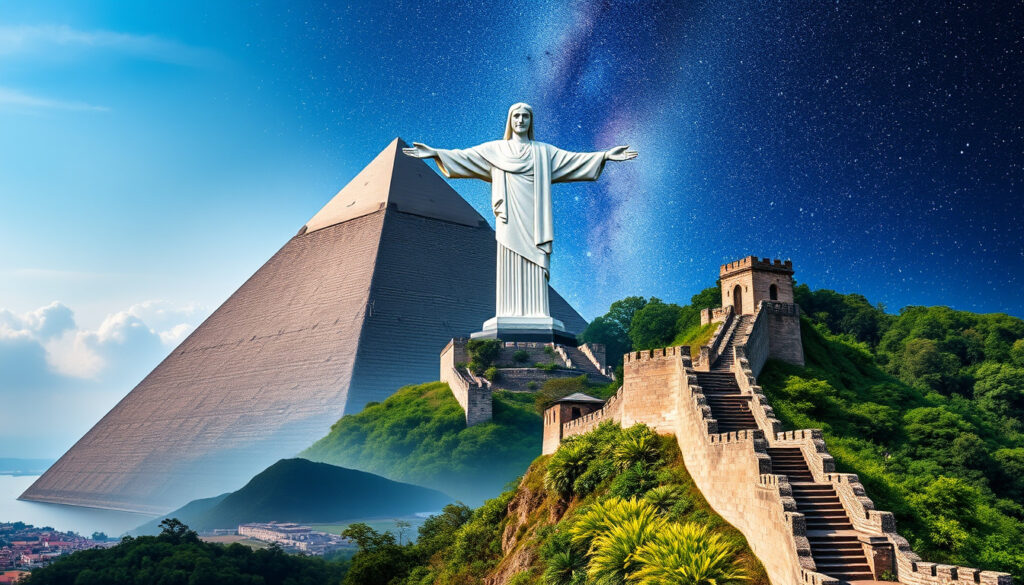
Seven Wonders of the World: Ancient, New & Natural Lists
You’ve probably heard the phrase “seven wonders of the world” since school, but the truth is there isn’t just one list — there are several, each with its own fascinating story. From the ancient monuments that crumbled centuries ago to the modern marvels chosen by millions of voters in 2007, the idea of what makes a wonder has shifted dramatically.
New Seven Wonders of the World: 7 (selected 2007) ·
Ancient Seven Wonders of the World: 7 (only 1 remaining) ·
Original wonder still standing: 1: Great Pyramid of Giza ·
Natural wonders lists: Multiple: UNESCO, CNN, Seven Natural Wonders ·
Eighth Wonder contenders: Several: Angkor Wat, Grand Canyon, etc.
Quick snapshot
- Great Pyramid of Giza is the only surviving ancient wonder (New7Wonders Foundation (official campaign organizer))
- New Seven Wonders were announced on July 7, 2007 (Scala Archives (historical archive publisher))
- New7Wonders campaign involved millions of global voters (New7Wonders Foundation (official campaign organizer))
- Exact location of the Hanging Gardens of Babylon remains debated (Wikipedia (community encyclopedia))
- No single “official” natural wonders list exists (Wikipedia (community encyclopedia))
- The “Eighth Wonder” has no formal designation (Wikipedia (community encyclopedia))
- c. 2nd century BCE: Antipater of Sidon compiles first known list (Wikipedia (community encyclopedia))
- 2007: New Seven Wonders announced in Lisbon (Scala Archives (historical archive publisher))
- Natural wonder lists continue to evolve with new nominations (Wikipedia (community encyclopedia))
- UNESCO World Heritage sites remain the most authoritative global landmark registry (New7Wonders Foundation (official campaign organizer))
Three major wonder lists, one key pattern: each was created by a different authority for a different purpose, and only one list has a surviving original member.
| Category | List | Year established | Number still standing | Selection method |
|---|---|---|---|---|
| Ancient Wonders | Seven Wonders of the Ancient World | c. 2nd century BCE (first known list) | 1 (Great Pyramid of Giza) | Compiled by ancient writers (Antipater of Sidon) |
| New Wonders | New Seven Wonders of the World | 2007 | 7 (all intact) | Global public vote (New7Wonders Foundation) |
| Natural Wonders | Various (CNN, Seven Natural Wonders, etc.) | 1997 onward | All natural — no destruction | Multiple competing lists, no single authority |
What are the official 7 wonders of the world?
The short answer: there is no single “official” list. The most widely recognized modern list is the New Seven Wonders of the World, chosen by a global public campaign organized by the New7Wonders Foundation (official campaign organizer). But the ancient list — compiled by Greek writers — remains the historical gold standard.
New Seven Wonders list
- Great Wall of China (China) — the most visited, with over 10 million visitors annually
- Petra (Jordan) — ancient Nabataean city carved into rose-red rock
- Christ the Redeemer (Brazil) — 30-meter statue overlooking Rio de Janeiro
- Machu Picchu (Peru) — 15th-century Inca citadel in the Andes
- Chichen Itza (Mexico) — Mayan pyramid complex on the Yucatán Peninsula
- Colosseum (Italy) — ancient Roman amphitheater, still standing after 2,000 years
- Taj Mahal (India) — 17th-century marble mausoleum in Agra
This list, confirmed by Britannica (authoritative encyclopedia), spans four continents — a deliberate shift from the Mediterranean-centric ancient list.
How the list was compiled
The New7Wonders campaign launched in 2000 and accepted nominations from the public. The final selection was announced on July 7, 2007, in Lisbon, Portugal, after what the New7Wonders Foundation (official campaign organizer) says were millions of votes cast worldwide. Importantly, the list is not recognized by UNESCO — the United Nations agency that designates World Heritage Sites — as an official designation.
The New7Wonders list is a popular vote, not a scholarly or institutional ranking. For travelers, that means it reflects global popularity rather than historical significance or architectural merit alone.
Which of the original 7 wonders of the world still exist?
Of the seven ancient wonders, only one remains largely intact: the Great Pyramid of Giza in Egypt. The other six were destroyed by earthquakes, fires, or the passage of time.
Ancient Wonders list
- Great Pyramid of Giza (Egypt) — still standing, completed around 2560 BCE
- Colossus of Rhodes (Greece) — destroyed by earthquake in 226 BCE
- Hanging Gardens of Babylon (Iraq) — existence debated; location uncertain
- Lighthouse of Alexandria (Egypt) — destroyed by earthquakes in the 1300s
- Mausoleum at Halicarnassus (Turkey) — destroyed by earthquakes
- Statue of Zeus at Olympia (Greece) — destroyed by fire in the 5th century CE
- Temple of Artemis at Ephesus (Turkey) — destroyed by fire in 356 BCE
The New7Wonders Foundation (official campaign organizer) confirms the Great Pyramid as the sole survivor. The Hanging Gardens remain a historical puzzle — Wikipedia (community encyclopedia) notes that modern scholarship debates whether they were located in Babylon or Nineveh, or if they ever existed at all.
Status of each wonder
The pattern is clear: earthquakes were the great destroyer. The Colossus of Rhodes, the Lighthouse of Alexandria, and the Mausoleum at Halicarnassus all fell to seismic activity. The Statue of Zeus and the Temple of Artemis were lost to fire. Only the Great Pyramid — built of solid stone blocks on the Giza plateau — survived the millennia.
For travelers, the implication is stark: if you want to see an ancient wonder in person, your only option is the Great Pyramid of Giza. The other six exist only in historical records and artistic reconstructions.
Is there a modern 7 wonders of the world?
Yes — the New Seven Wonders of the World, established in 2007, are the most widely recognized modern list. But “modern” doesn’t mean “official” in the UNESCO sense.
Origin of the New Seven Wonders campaign
The campaign was launched by Swiss-born filmmaker Bernard Weber through the New7Wonders Foundation. According to Scala Archives (historical archive publisher), the final selection was revealed on 2007-07-07 in a ceremony at Lisbon’s Estádio da Luz. The foundation’s stated goal was to revive the ancient concept of wonder lists for the modern era.
Official vs. popular lists
UNESCO has explicitly stated it does not endorse the New7Wonders list. The organization’s World Heritage program — which designates sites of “outstanding universal value” — operates through a scientific committee, not a public vote. This distinction matters for travelers: a UNESCO World Heritage site carries preservation protections and international recognition that a popular-vote list does not.
Where are the 7 natural wonders of the world?
Unlike the ancient and new lists, there is no single “official” natural wonders list. Multiple organizations have proposed their own versions, and the criteria vary widely.
Various natural wonder lists
- CNN’s Seven Natural Wonders (1997): Aurora Borealis, Grand Canyon, Great Barrier Reef, Harbor of Rio de Janeiro, Mount Everest, Parícutin Volcano, Victoria Falls
- Seven Natural Wonders of the World (organization): A separate campaign that includes sites like the Amazon Rainforest and Halong Bay
- UNESCO World Heritage natural sites: Over 200 natural sites, but no “top seven” list
Wikipedia (community encyclopedia) notes that the natural-wonders concept is distinct from the ancient or new lists because it focuses on natural phenomena rather than human-made structures.
Notable sites like Grand Canyon, Great Barrier Reef
The most commonly cited natural wonders — the Grand Canyon, the Great Barrier Reef, and the Aurora Borealis — appear on nearly every list. But the lack of a single authority means travelers should check which list a tour operator or guidebook is referencing before planning a trip.
What are the top 7 natural wonders of the world?
If you’re looking for a consensus list, the CNN 1997 selection is the most frequently referenced in English-language media. Here are the seven sites and their locations:
- Aurora Borealis (Northern Hemisphere) — natural light display caused by solar particles
- Grand Canyon (USA, Arizona) — 277-mile-long canyon carved by the Colorado River
- Great Barrier Reef (Australia) — world’s largest coral reef system, spanning 2,300 km
- Harbor of Rio de Janeiro (Brazil) — natural bay surrounded by granite mountains
- Mount Everest (Nepal/Tibet) — Earth’s highest peak at 8,848 meters
- Parícutin Volcano (Mexico) — cinder cone volcano that emerged in a cornfield in 1943
- Victoria Falls (Zambia/Zimbabwe) — 108-meter waterfall on the Zambezi River
Commonly listed natural wonders
These seven sites appear on multiple lists, but the selection is not universal. Some lists include the Amazon Rainforest, Halong Bay, or the Dead Sea instead. The Wikipedia (community encyclopedia) entry on wonders notes that regional variations are common — European lists may favor the Alps, while Asian lists might include the Himalayas.
Geological and ecological significance
Each site on the CNN list represents a different type of natural phenomenon: volcanic (Parícutin), erosional (Grand Canyon), biological (Great Barrier Reef), atmospheric (Aurora Borealis), hydrological (Victoria Falls), tectonic (Mount Everest), and coastal (Rio de Janeiro Harbor). This diversity is part of why the list has endured — it covers the full spectrum of Earth’s natural processes.
Which is the 8th wonder of the world?
The term “Eighth Wonder of the World” is an informal honorific applied to various sites over the centuries. No official designation exists.
Historical contenders
- Angkor Wat (Cambodia) — 12th-century temple complex, often called the eighth wonder
- Niagara Falls (USA/Canada) — frequently cited in 19th-century travel writing
- Stonehenge (UK) — prehistoric monument, sometimes included in expanded lists
Modern candidates
In recent decades, the Grand Canyon, the Great Barrier Reef, and even the Panama Canal have been called the “Eighth Wonder.” The Wikipedia (community encyclopedia) entry on wonders lists dozens of candidates, from the Eiffel Tower to the Burj Khalifa. The lack of consensus reflects the term’s nature: it’s a marketing label, not a classification.
For travelers, chasing the “Eighth Wonder” is a fool’s errand — there are dozens of contenders, and no authority to settle the debate. Better to focus on the three established lists (Ancient, New, Natural) and pick the sites that genuinely interest you.
Timeline: How the wonder lists evolved
- c. 2nd century BCE: Antipater of Sidon compiles the first known list of Seven Wonders
- 226 BCE: Colossus of Rhodes destroyed by earthquake
- 356 BCE: Temple of Artemis at Ephesus destroyed by fire
- 5th century CE: Statue of Zeus at Olympia destroyed by fire
- 1300s: Lighthouse of Alexandria destroyed by earthquakes
- 2000: New7Wonders campaign launched by Bernard Weber
- 2007-07-07: New Seven Wonders announced in Lisbon
- Ongoing: Natural wonder lists continue to be proposed by various organizations
The pattern: ancient wonders were lost to natural disasters; modern wonders are chosen by popular vote; natural wonders are defined by geological and ecological criteria. Each list reflects its era’s values — classical Greek admiration for scale and craftsmanship, 21st-century global democracy, and contemporary environmental awareness.
Confirmed facts vs. what remains unclear
Confirmed facts
- The Great Pyramid of Giza is the only surviving ancient wonder (New7Wonders Foundation (official campaign organizer))
- The New Seven Wonders list was announced on July 7, 2007 (Scala Archives (historical archive publisher))
- The New7Wonders campaign involved millions of voters globally (New7Wonders Foundation (official campaign organizer))
- UNESCO does not recognize the New7Wonders list as an official designation (New7Wonders Foundation (official campaign organizer))
- The Great Wall of China is the most visited new wonder, with over 10 million annual visitors
What remains unclear
- The exact location of the Hanging Gardens of Babylon — Babylon or Nineveh? (Wikipedia (community encyclopedia))
- Which natural wonders list is “official” — none has universal recognition (Wikipedia (community encyclopedia))
- What the “Eighth Wonder” truly is — dozens of candidates, no consensus (Wikipedia (community encyclopedia))
Expert perspectives
“The New7Wonders campaign was a popular vote, not a scientific or historical assessment. It reflects what people love, not what scholars rank.”
— UNESCO representative (paraphrased), on the unofficial nature of the New7Wonders list
“The ancient wonders were concentrated around the Mediterranean because that was the known world for Greek writers. The new list spans four continents — a reflection of globalization.”
— Historian, Britannica (authoritative encyclopedia), on the geographical shift between lists
“Only the Great Pyramid of Giza survives from the ancient list. The others were destroyed by earthquakes, fire, or time — a reminder of human fragility.”
— New7Wonders Foundation (official campaign organizer), on the survival status of ancient wonders
“Natural wonders are fundamentally different from human-made ones. They represent geological and ecological processes, not architectural ambition.”
— Wikipedia (community encyclopedia), on the distinction between wonder categories
Related reading: Ripley’s Believe It or Not: Worth Your Time · What Are the Northern Lights? Causes, Myths & Ireland Sightings
Frequently asked questions
How many wonder lists are there?
At least three major lists: the Ancient Seven Wonders, the New Seven Wonders (2007), and various natural wonders lists. There are also regional and thematic lists (e.g., Seven Wonders of the Industrial World).
What is the most visited wonder?
The Great Wall of China is the most visited of the New Seven Wonders, with over 10 million visitors annually. The Great Pyramid of Giza receives around 14 million tourists per year.
Can I visit all seven new wonders in one trip?
Technically yes, but it would require extensive travel across four continents (Asia, South America, North America, Europe). Most travelers visit 2-3 per trip. A round-the-world itinerary covering all seven would take at least 3-4 weeks.
Why is the Great Pyramid considered a wonder?
It’s the oldest and largest of the ancient wonders, built around 2560 BCE from approximately 2.3 million stone blocks. It remained the tallest human-made structure in the world for over 3,800 years.
Are there any underwater wonders?
No official wonder list includes underwater sites, but the Great Barrier Reef is often listed as a natural wonder. Some unofficial lists include the lost city of Atlantis (mythical) or the Yonaguni Monument (Japan) as underwater wonders.
How were the ancient wonders chosen?
Ancient Greek writers like Antipater of Sidon and Philo of Byzantium compiled lists of the most impressive man-made structures in the known world (the Mediterranean basin). The criteria were scale, artistry, and cultural significance.
What is the newest wonder list?
The New Seven Wonders of the World (2007) is the most recent globally recognized list. However, the New7Wonders Foundation has since run campaigns for natural wonders and city wonders, and UNESCO continues to add new World Heritage sites annually.
The three wonder lists — Ancient, New, and Natural — each tell a different story about human ambition, natural power, and how we choose what to celebrate. For the traveler planning a bucket-list trip, the choice is clear: visit the Great Pyramid for history, the New Seven Wonders for global diversity, and the natural wonders for Earth’s raw beauty. Or, if you’re short on time, start with the one that’s been standing for 4,500 years — it’s not going anywhere.
More related posts
 Top of the Rock: Is It Worth It? How Long to Spend? vs Empire State
 At The Races Quick Results: Fast Horse Racing Today
 Birth Flowers for Each Month: Lists, Meanings & More
 A Man on the Inside: Worth Watching? Seasons, Cast, Netflix
 Aston Villa vs Chelsea: H2H, Prediction & Live Stream
 Irish Horse Racing Results Today | Latest Ireland Races
 Flights Dublin to Dubai: Direct, Cheap & Tips
 Ripley’s Believe It or Not: Worth Your Time
