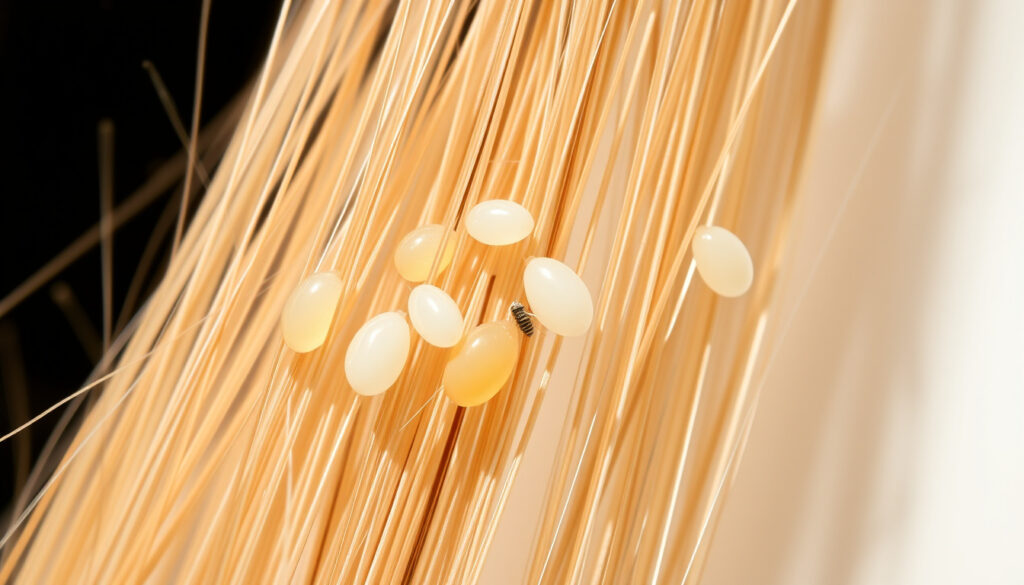
What Do Nits Look Like: Pictures, Colors & Identification Guide
You’re doing a routine check—shampooing, conditioning, running fingers through—when you spot them: tiny white specks clinging to hair strands near the scalp. Your stomach drops. Before panicking or reaching for the heavy-duty treatments, know this: research from health authorities shows that roughly 60 percent of parents mistake ordinary dandruff for head lice eggs during home checks, which means your first job is getting the identification right. The CDC offers a straightforward test that separates nits from flakes in seconds.
Color: yellow, brown, or white · Shape: tiny ovals · Location: attached to hair shaft near scalp · Visibility: easier on dark hair; behind ears · Size: small dots like sesame seeds
Quick snapshot
- Nits are firmly cemented to hair within 6 mm of the scalp (CDC)
- Yellow, brown, or white ovals; 0.8 mm long (Lice Lifters Nassau County)
- Exact survival duration of nits once detached from hair (Lice Lifters Nassau County)
- Whether viable nits can incubate off-host long enough to infect new hosts from bedding alone (Lice Lifters Nassau County)
- Nits hatch 7-10 days after being laid (Lice Lifters Nassau County)
- Nits more than ¼ inch from the scalp indicate old infestation (CDC)
- Live lice treatment required if hatching is confirmed; nits alone may not indicate active infestation
- Regular combing and follow-up application essential for clearance
The comparison table below breaks down the visual and physical differences between live nits, hatched nits, and dandruff to help you identify what you are dealing with.
| Label | Value |
|---|---|
| Typical Color | Yellow, brown, white |
| Attachment Point | Hair shaft close to scalp |
| Live vs. Empty | Live: brown/tan; Empty: white shells |
| Best Detection | Comb wet hair; look behind ears |
What do nits look like?
Nits are the eggs of head lice—small, oval-shaped structures laid by adult female lice at the base of hair strands. Each nit measures roughly 0.8 millimeters in length, about the size of a sesame seed, and is cemented firmly within 6 millimeters of the scalp (Lice Lifters Nassau County). Under 10x magnification, nits display a distinct operculum cap, a ridged shell, and—if viable—a visible embryo inside. Empty hatched casings, by contrast, appear white or clear.
Dandruff behaves the opposite way. Loose skin cells from the scalp slide off easily and often land on the scalp surface itself, not attached to hair strands. The CDC’s recommended distinction test is simple: attempt to flick or pull off a white speck. Dandruff comes away without resistance; nits do not (CDC Head Lice Flyer).
What do nits look like to the human eye?
Without magnification, nits appear as tiny brown or tan dots pressed flat against the hair shaft, often mistaken for dried product or debris. They catch light differently than flakes, giving them a slightly iridescent quality. The color varies: viable nits range from translucent tan to coffee-brown because the embryo inside is visible; hatched nits turn white or clear and cling to the hair long after the young lice have departed (Lice Lifters Nassau County).
What do nits look like close up?
Under magnification, nits reveal their teardrop or leaf-like shape with the operculum cap at the top—the opening through which the nymph eventually emerges. Viable eggs contain a visible embryo; non-viable or hatched eggs are hollow shells. Dandruff, observed under the same magnification, appears amorphous with irregular edges and no defined structure (Lice Clinics of America).
What do nits look like on a comb or paper towel?
When passed through wet, conditioned hair with a fine-toothed nit comb, nits that have loosened from the hair shaft collect between the teeth or fall onto a light surface where they are easier to examine. On a white paper towel, viable brown nits stand out clearly against the background, while empty white casings may resemble small flakes—making the flick test still useful even when inspecting comb catchings.
What can be mistaken for a nit?
Nits are often confused with dandruff, hair spray droplets, residue from hair products, or dirt particles (CDC About Head Lice). The CDC recommends using a magnifying lens to confirm what you are seeing. The key distinction is always attachment: nits adhere to the hair shaft; dandruff and debris do not.
Differences from dandruff or debris
Dandruff is loose scalp skin that flakes off and moves freely—it does not remain fixed to individual hair strands. Nits, by contrast, are biologically cemented to the hair cuticle by secretions from the adult louse. Dandruff is a chronic skin condition; a lice infestation is temporary and requires targeted treatment (Medical News Today). When checking, examine hair under bright light and focus on the areas behind the ears, the nape of the neck, and along the scalp line—these are where lice deposit their eggs most frequently.
Roughly 60 percent of parents misidentify dandruff as lice eggs during home checks. When in doubt, the flick test separates the two in seconds.
The implication is that unnecessary treatment, expense, and stress are common outcomes when visual inspection is the only tool used.
How do I know if I got nits?
Nits alone do not always mean an active infestation. According to the CDC, nits located more than ¼ inch from the scalp have already hatched and represent an old infestation that does not require treatment (CDC About Head Lice). An active infestation requires confirmation of live lice as well as nits.
How do you know if you actually have lice?
Live lice are about the size of a sesame seed and move close to the scalp, making them harder to spot than nits. They avoid light and cling to hair strands, so checking with a bright light or a magnifying glass improves visibility. Wet combing—running a fine-toothed nit comb through wet, conditioned hair—collects both live lice and nits and is a reliable detection method recommended by the NHS (NHS).
What are the first signs of having lice?
Persistent itching on the scalp, behind the ears, or at the nape of the neck is the most common early symptom. Both lice and dandruff cause itching, so it is not diagnostic on its own—but combined with confirmed nits or a positive wet comb result, it strengthens the case for active infestation. Some people develop a rash from irritation, particularly at the back of the neck.
Do nits go away by themselves?
No. Nits require active treatment because they will hatch if left in place. A nit can remain viable for up to 10 days before hatching, and each adult female louse lays 6-8 eggs per day (Lice Lifters Nassau County). Without treatment, the cycle continues indefinitely. Removing nits mechanically with a nit comb or applying a pediculicide treatment that kills both lice and eggs are the two primary approaches.
Over-the-counter treatments kill live lice but may not destroy all nits. Repeating the treatment after 7-10 days—after any eggs have hatched but before they can lay new eggs—is standard practice.
What kills lice immediately?
No treatment eliminates head lice instantly. The most widely used over-the-counter option is permethrin 1% shampoo, which the CDC lists as a standard treatment when applied and rinsed according to label instructions (CDC About Head Lice). Prescription treatments are available through a healthcare provider for cases that do not respond to initial over-the-counter products. The treatment step-by-step below covers the standard approach.
What kills head lice quickly?
A combination approach works fastest: apply a pediculicide treatment, repeat after the hatching window of 7-10 days, and comb the hair daily with a fine nit comb to remove any survivors. The key is timing—catching newly hatched nymphs before they mature and lay more eggs.
What kills hair lice instantly?
Heat can kill lice on the spot—adult lice cannot survive temperatures above approximately 125°F (52°C) for more than a few minutes. However, home heat treatments are not universally reliable for eliminating nits, which are more heat-resistant. The safest and most evidence-backed method remains FDA-approved topical treatments followed by mechanical removal.
How to identify and treat nits step by step
Step 1: Examine the scalp and hair under bright lighting, focusing on behind the ears, the nape of the neck, and the hairline. Nits cluster near these areas because lice prefer warm, protected spots.
Step 2: Perform the flick test on any white specks. Use your fingernails or a fine tool to attempt to slide the speck off the hair shaft. If it moves easily, it is likely dandruff or debris. If it does not budge, it is a nit.
Step 3: Wet comb with a fine-toothed nit comb through conditioned hair. Work from the scalp to the ends, wiping the comb on a white paper towel after each pass. Live lice and dislodged nits collect on the towel or between comb teeth.
Step 4: Identify live versus hatched nits. Brown or tan nits attached close to the scalp are viable and require treatment. White or clear casings farther from the scalp are hatched shells from a past infestation.
Step 5: Apply an FDA-approved treatment such as permethrin 1% shampoo if live lice or viable nits are confirmed. Follow the product instructions carefully, leaving the treatment on for the full recommended time.
Step 6: Repeat the treatment after 7-10 days to kill any nits that have hatched since the first application. Continue daily nit combing to catch survivors.
The pattern becomes clear once the data assembles: nits that are firmly attached, uniformly sized, and located close to the scalp warrant treatment. Hatched shells farther from the scalp do not. The CDC’s flick test is the fastest way to tell the difference without any equipment.
Upsides
- Nits are visually distinct from dandruff once you know the flick test
- Effective treatments exist and are widely available
- Confirmed hatched nits require no treatment—saving unnecessary chemical exposure
- CDC and NHS guidance is clear, consistent, and publicly accessible
Downsides
- No instant cure; treatment spans multiple days
- Approximately 60 percent of parents misidentify dandruff as nits at home
- School nurses correctly identify actual lice in only 41 percent of suspected cases
- Over-the-counter treatments may require two applications
“To distinguish between dandruff and nits, try to flick or pull off the white speck. Dandruff is easily pulled off, but nits are not.”
CDC (U.S. Health Authority)
“Nearly 60 percent of parents misidentify dandruff flakes as lice eggs during a home check.”
Lice Lifters Nassau County (Lice Treatment Service, citing 2019 study)
“A 2015 study in Pediatric Dermatology examined 600 samples submitted by school nurses… only 41 percent were actual nits.”
Lice Lifters Nassau County (Lice Treatment Service)
The misidentification problem runs deeper than casual home checks. A 2015 study published in Pediatric Dermatology found that school nurses—who are among the most practiced screeners—correctly identified actual lice in only 41 percent of submitted samples, with the remainder being dandruff or residue. Parents, without that professional training, face an even higher error rate. The implication is that unnecessary treatment, expense, and stress are common outcomes when visual inspection is the only tool used.
Nits are viable eggs only when they are brown or tan, firmly attached, and within 6 mm of the scalp. White casings farther down the hair shaft are hatched leftovers. The CDC’s flick test makes this distinction in seconds.
For families dealing with suspected lice, the choice is straightforward: confirm first with the flick test or a nit comb, treat only if viable nits or live lice are present, and repeat the treatment after the 7-10 day hatching window. For anyone uncertain whether they have an active infestation, a professional screening takes the guesswork out of the equation and prevents unnecessary chemical exposure for children whose scalps are still developing.
Related reading: Northern Lights appearance and sightings · Big Bang Theory visual explanation
prevention.com, myliceadvice.com, licelifters.com, headandshoulders.co.uk, resources.healthgrades.com, maine.gov
Nits appear as tiny yellow, brown or white ovals glued to hair shafts, just as the visual guide to spot lice eggsdistinctly illustrates against common confusions like dandruff.
Frequently asked questions
Where do lice come from?
Head lice (Pediculus humanus capitis) spread through direct head-to-head contact or sharing of personal items such as hats, hairbrushes, and pillows. They do not jump or fly. Lice transferred from another person settle on a new scalp and begin laying eggs within days.
Do lice stay on pillows?
Lice can survive off the scalp for up to 1-2 days, which means they may temporarily be on bedding. However, they prefer human blood and cannot feed on anything else, so pillows are a transmission risk only for that brief window, not a primary source of infestation.
Can lice live in pillows?
Lice cannot live long on pillows or bedding because they need a human host to feed and survive. Washing bedding at 130°F (54°C) or sealing it in a plastic bag for 48 hours kills any stray lice or nits that may have transferred.
How to remove lice from hair permanently
Permanently removing lice requires a two-step approach: eliminating live lice and their eggs with a pediculicide treatment, then repeating the treatment after 7-10 days to catch newly hatched nymphs. Daily nit combing between treatments accelerates the process and confirms whether the infestation is resolving. Machine-drying bedding on high heat and cleaning personal items completes the clearance.
Can nits hatch on bedding?
Nits require body heat to incubate and hatch. Once separated from the scalp, nits on bedding or pillows cool and typically do not hatch. The primary risk of infestation comes from direct head-to-head contact, not from environmental sources.
How long can nits survive off the scalp?
Nits separated from the scalp are unlikely to hatch successfully because they lose the warmth needed for incubation. Survival off-host is limited, and the primary route of infestation remains direct contact with an infected person’s hair or head.
What does a nit look like compared to a louse?
A nit is a tiny oval egg, roughly 0.8 mm, cemented to the hair shaft near the scalp. A louse is a larger, six-legged insect roughly the size of a sesame seed that moves on the scalp and through the hair. The two are distinct life stages: nits are the egg phase; lice are the active parasitic phase.
Is it possible to have nits but no lice?
Yes. Hatched nits—white or clear casings farther from the scalp—can remain attached to hair long after the live infestation has cleared. These old nits do not indicate an active problem and do not require treatment. Confirming live lice is the key diagnostic step before starting any treatment regimen.
More related posts
 La Marzocco Coffee Machine: Price, Models, and Why It’s Expensive
 Laurel Hill Secondary School FCJ: Key Facts & Info
 Huda Beauty Setting Powder – Complete Guide and Review
 Pizza Offers Near Me – Top Chain Deals and Promo Codes
 Ryanair Flights to Malaga: Cheap Fares & Tips
 Weather Warning Ireland Wind: Met Éireann Alerts & Storm Updates
 The Open 2025 Leaderboard: Payouts & Results at Royal Portrush
